I use Codex to review plans and review work. If I run out of Claude subscription time for the week, Codex becomes my primary tool.
My daily driver, though, is Claude Code, Claude Cowork, and Live Artifacts for project management. I absolutely love Live Artifacts.
I also use OpenCode from time to time and was a regular Gemini CLI user. I’m still salty that Google decided to EOL Gemini CLI. It was getting better and better, and then they just killed it. Really?
I tried the older version of Antigravity and was very impressed. I haven’t touched the new Antigravity CLI yet. Between everything else available and how disappointed I still am about Gemini CLI, it’s just not high on my list.
I do use Gemini Deep Research and NotebookLM regularly. I’m also a big fan of Perplexity’s Computer Use mode and Deep Research, and I’m even considering buying the Perplexity personal computer.
Claude remains my go-to, especially after Anthropic doubled usage limits following the SpaceX hosting changes. I’m on Double Max and try to do as much as possible there.
I use ChatGPT primarily for image generation, summarization, and getting a second opinion on things. I use Grok when I want to review contracts, compare document versions, or perform similar analysis. I’ve also experimented with Grok Build, though not the very latest release. Of all the newer entrants, it’s the one I think has the potential to eclipse many of the others.
Codex Desktop also looks interesting.
Honestly, it’s hard to keep up with the pace of innovation. That’s why Google’s decision to abruptly kill Gemini CLI makes so little sense to me. A lot of tools had already ported Claude plugins and similar integrations to Gemini CLI, Codex, and OpenCode, only to have Gemini disappear overnight.
It was a bad move that frustrated a lot of developers. Gemini CLI had real momentum, and then Google pulled the plug.
If you’re interested in my thoughts on Grok Build, check out my article and, if you enjoy it, like, subscribe, and follow. 🙂
Agent-Memory — The key to salient episodic memory for AI Agents
Agent-Memory — The key to salient episodic memory for AI Agents
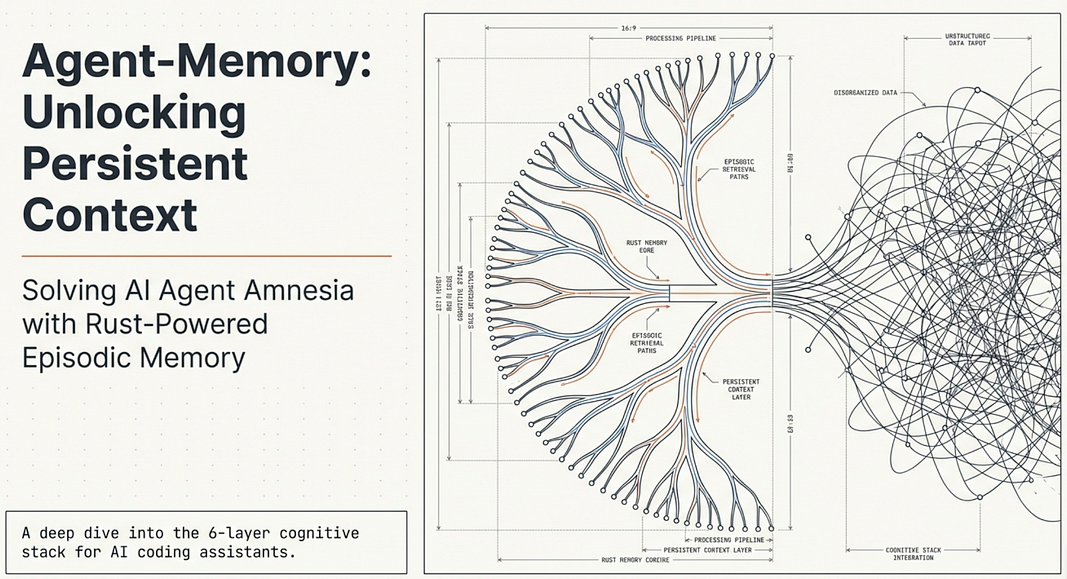
Unlocking Persistent Context: Solving AI Agent Amnesia with Advanced Episodic Memory Systems
Tired of your AI coding assistant forgetting crucial details after every session? Discover how a Rust-powered memory system can solve the amnesia problem and provide your AI with the persistent context it needs to boost your productivity! Dive into the future of AI with our latest article on Agent-Memory! #AIMemory #CodingAssistant
Summary: A Rust-powered, append-only, episodic, salient conversational memory system addresses the amnesia problem in AI coding assistants by providing episodic memory, allowing agents to recall past conversations and decisions. It distinguishes between library memory (static documents) and episodic memory (dynamic conversation history), utilizing a six-layer cognitive stack for efficient retrieval. Salience detection prioritizes important memories, while an append-only design ensures raw events are retained indefinitely. The system supports multi-agent memory sharing through various strategies, enhancing collaborative coding experiences. It also support index eviction to keep the most recent and most salient memories in the index without blowing up you RAM budget.
This is a work in progress. A side quest that I have been working on.
AI Agent — Agent Memory — Deep Dive into the six layer cognitive stack for AI Agents
How a Rust-powered, append-only conversational memory system solves the AI agent amnesia problem and gives AI coding assistants persistent context
Introduction: The Amnesia Problem
Your AI coding agent forgot everything again.
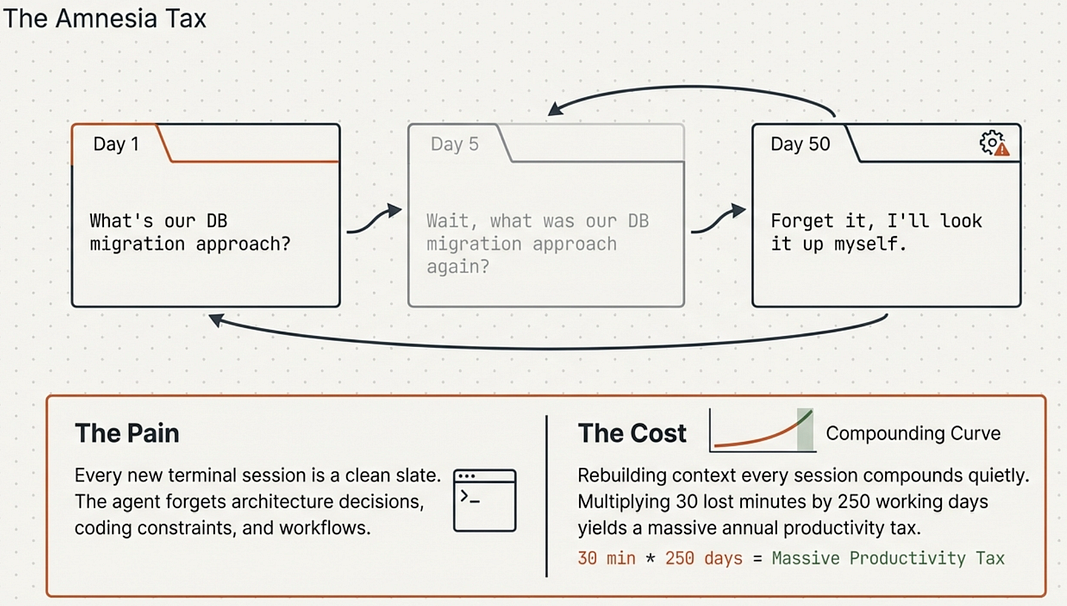
AI Agent Amnesia Tax
Not last week’s architecture decision. Not the constraint your team established in January about never exposing secrets in logs. Not the careful approach you worked out together for the database schema migration that took three sessions to get right. Gone. Every new terminal session, every new conversation window: a clean slate. The agent greets you like a stranger.
This is not a bug in your agent. It is a fundamental gap in how AI coding assistants work today. They have powerful reasoning, deep programming knowledge, and sophisticated code generation. What they lack is episodic memory: the ability to remember what the two of you have done together. Without persistent AI agent context, every session is a reset.
The cost compounds quietly. You rebuild context every session. You re-explain constraints the agent already helped you establish. You re-discover decisions that took an hour the first time. Multiply that by 250 working days a year and you understand why the amnesia problem is a real productivity tax, not just a minor annoyance.
We have all experienced this. We updated AGENTS.md, add hooks, cuss, and complain but sometimes it just forgets something.
To fix this properly, start with one distinction: agents need two fundamentally different types of memory.
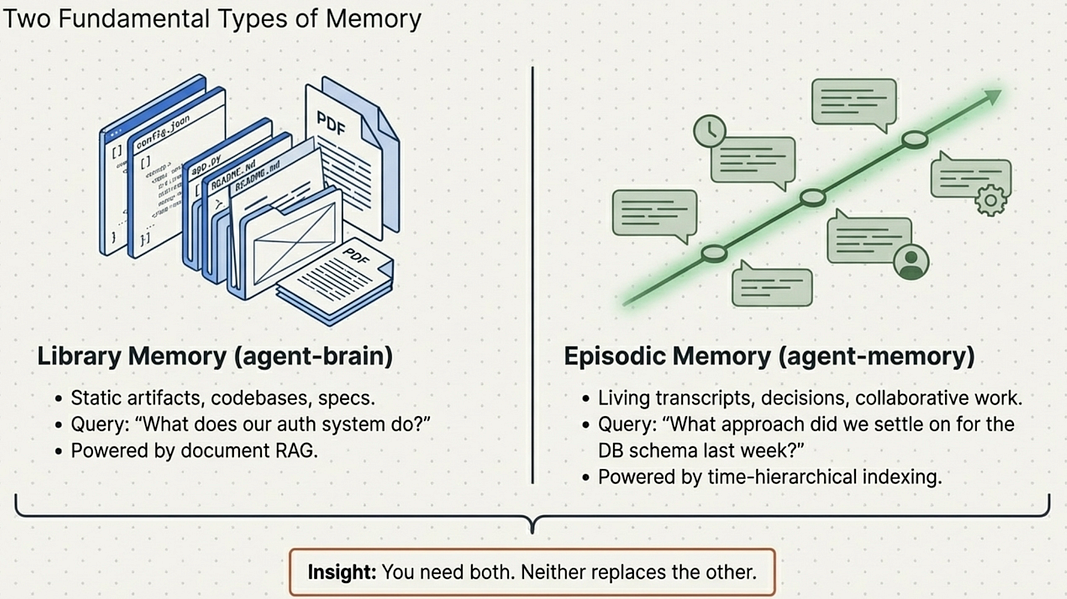
The first is library memory: knowledge about documents, code files, specifications, and domain concepts. Systems like agent-brain and spec driven development tools like BSD, BMAD, SuperPowers, etc., cover this. You index your codebase, feed it PDFs, and ask “what does our auth system do?” The agent retrieves a relevant chunk.
The second is episodic memory (conversational memory): knowledge about conversations themselves. Not what a document says, but what you and your agent discussed, decided, and built together. This is the memory you need when you ask “what approach did we settle on for the database schema last week?” or “what was that trick we used to fix the slow query in March?”
AI Agent Memory: Library Memory and Episodic Memory — episodic is internal dialog, conversations, and past decisions, discoveries and mistakes.
Library memory indexes static artifacts. Episodic memory captures a living transcript of collaborative work. Different data shapes, different access patterns, and different storage architectures require different systems.
Agent-memoryis built for episodic memory. It captures every conversation event automatically through hooks, organizes those events into a time-hierarchical index called the Table of Contents (TOC), and retrieves relevant context through a six-layer cognitive search stack. It is not a document RAG system or a generic AI agent memory RAG alternative: it is a specialized journal for an agent’s working life, with an intelligent filing system attached.
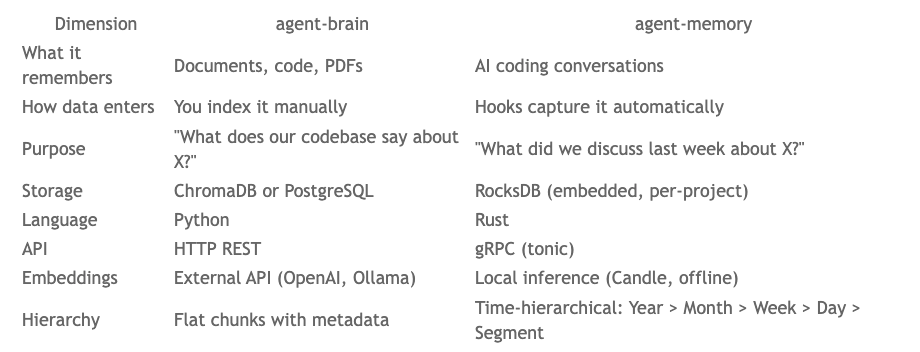
Here is how the two systems compare:
One sentence summary: agent-brain gives an agent library memory. agent-memory gives an agent episodic memory for AI agents. Both are necessary. Neither replaces the other.
Side Quest and Looking for Feedback and Collaborator not users yet
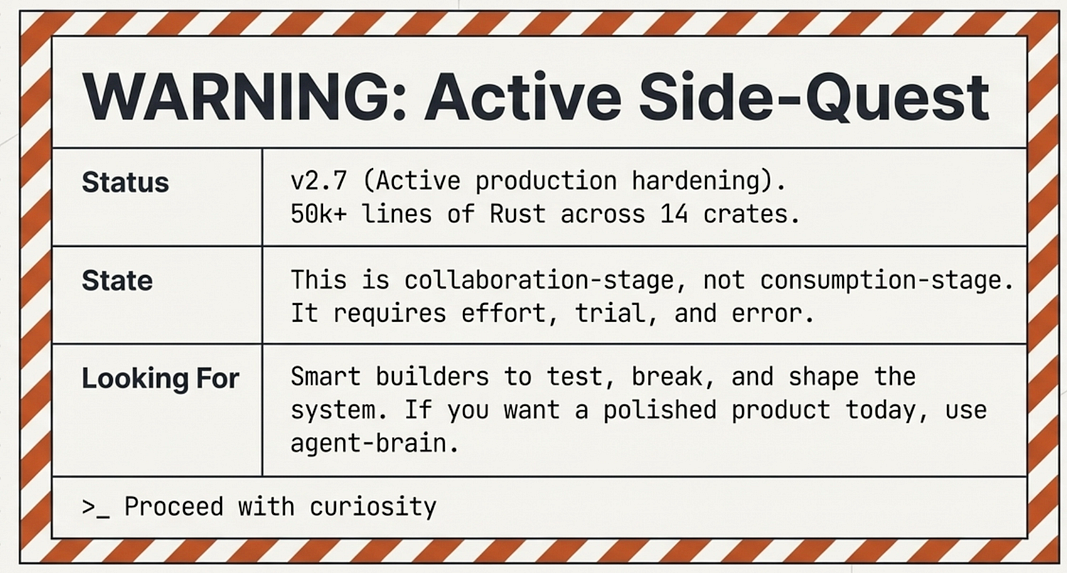
🚨🚨 WARNING — WORK IN PROGRESS / NOT PRODUCTION READY 🚨🚨
Okay — this article is more of a blog than an article talking about a polished product. It’s a stream-of-consciousness look into a project I’ve been building called agent-memory.
This is a background project I’ve been iterating on for a while. It’s full of ideas, experiments, and directions; but it is not finished.
I’m actively looking for people who want to:
Give feedback
Break things
Help test and shape the system
Potentially collaborate on building it out
⚠️ This will require effort. There will be trial and error. Things will change.
The core idea: build a fast, runtime memory system for agents that can:
Remember salient topics
Track preferences, tasks, and episodes
Retain important context over configurable time windows
Dynamically adjust what stays “important” in memory
But let’s be clear:
🚨 This is NOT a “ready-to-use tool” 🚨 This is NOT stable 🚨 This is NOT something you should rely on in production
This is an in-progress system that I’m putting out early on purpose.
I’m looking for:
Smart people interested in agent memory systems
Builders who want to experiment
People willing to test, break, and iterate
Anyone excited about pushing this space forward
If you’re just looking for something polished and ready; this isn’t it. Not yet anyway.
If you want something production-ready, check out other projects like agent-brain. We are promoting the use of agent-brain and want people to try it out and use it. It is ready for consumption.
👉 This project is different. This is collaboration-stage, not consumption-stage.
I’m sharing it because I want help from people smarter than me — or just motivated enough to try things out and give honest feedback.
So yeah… this is a side quest. It’s evolving. It’s rough.
And that’s exactly why I’m putting it out there.
Here are some agent memory systems that you can use today:
MemMachine
Mem0
OpenClaw (default memory)
LangGraph / LangChain memory
LlamaIndex memory
AutoGPT memory
CrewAI memory
I won’t compare AgentMemory systems to these because agent-memory is not done, but I will say it endeavors to be a better version of agent-memory than some of these other systems. Perhaps when it is further along a comparison article will be in order.
What agent-memory Does (or will do)
The core promise of agent-memory, stated in its own documentation: “Agent can answer ‘what were we talking about last week?’ without scanning everything.”
That phrase “without scanning everything” is doing a lot of work. The naive approach to an AI agent memory system is brute-force: dump all conversation history into a vector store and similarity-search at query time. This works until your history grows past a few thousand conversations. Then recall quality degrades, latency spikes, and retrieval becomes expensive.
Agent-memory takes a different approach. It builds a hierarchical summary structure over your conversations so an agent can navigate using O(log N) lookups instead of O(N) scans. It classifies memories by type so high-importance information survives longer and ranks higher. It layers search modalities intelligently: keyword search, semantic search, and graph traversal all feed into a ranking layer that surfaces the most relevant results.
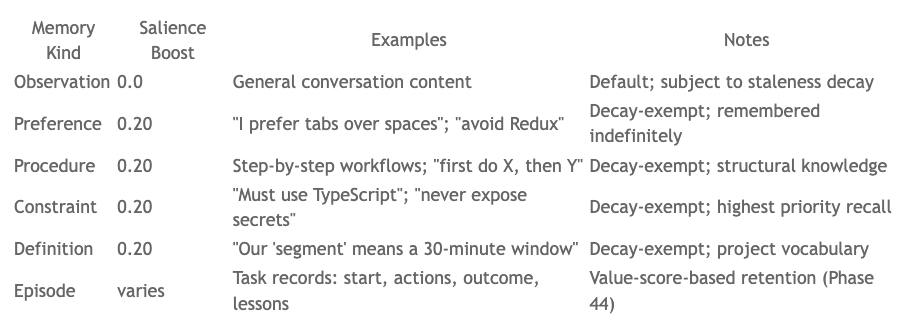
The system captures six types of memory:
Observation
Salience Boost: 0.0
Examples: General conversation content
Notes: Default; subject to staleness decay
Preference
Salience Boost: 0.20
Examples: “I prefer tabs over spaces”; “avoid Redux”
Notes: Decay-exempt; remembered indefinitely
Procedure
Salience Boost: 0.20
Examples: Step-by-step workflows; “first do X, then Y”
Notes: Decay-exempt; structural knowledge
Constraint
Salience Boost: 0.20
Examples: “Must use TypeScript”; “never expose secrets”
Notes: Decay-exempt; highest priority recall
Definition
Salience Boost: 0.20
Examples: “Our ‘segment’ means a 30-minute window”
We are just looking for important things to remember. Later you can recall these without friction. The agent starts to remember your preferences, experiences, workflows, etc.
Observation is the default. Everything that does not match a higher-signal pattern becomes an observation. Preferences, procedures, constraints, and definitions get salience boosts and escape the staleness decay that dims older memories over time. Episodes are task-level records that capture structured execution history.
This taxonomy matters in practice. When your agent from six months ago decided that your team avoids a specific pattern, that constraint should still surface today. The AI agent memory system ensures it does.
Tech Stack: Why Rust and RocksDB
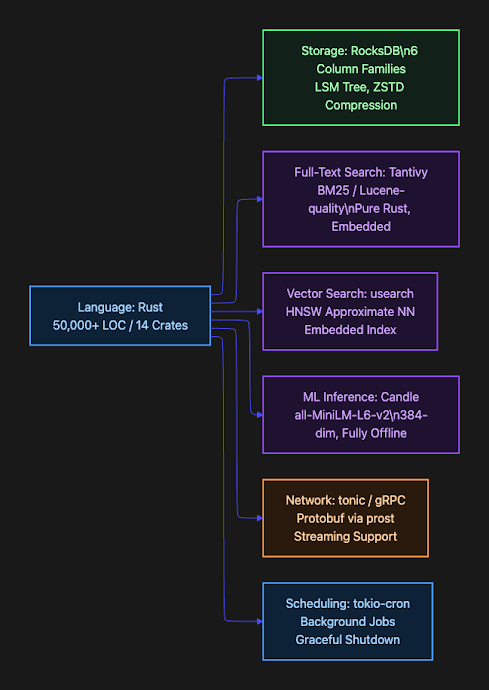
The entire agent-memory system is written in Rust: approximately 50,000 lines across 14 crates in a Cargo workspace. This Rust AI agent framework reflects specific requirements that guided every dependency selection.
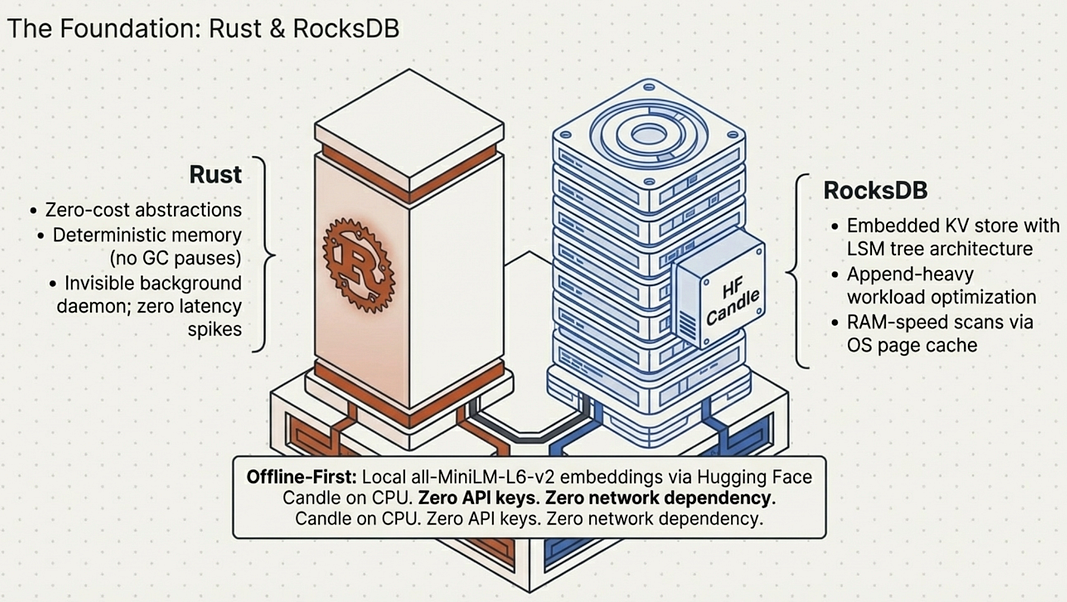
The Core Foundation, Rust, RocksDB, Candle, Offline focus
Rust was chosen for performance, memory safety, and the ability to run as a long-lived embedded daemon without a garbage collector pausing at inconvenient moments. An agent memory system needs to be invisible. If it adds latency or consumes memory unpredictably, developers stop using it. Rust’s zero-cost abstractions and deterministic memory model make it the right choice for a local background service.
RocksDB provides the persistent storage layer via the rust-rocksdb binding. It is an embedded key-value store that runs inside the daemon process: no separate database server to install, configure, or upgrade. RocksDB’s LSM tree structure is ideal for append-heavy workloads; writes are fast, and range scans over time-prefixed keys (the primary access pattern) are efficient. ZSTD compression keeps the storage footprint low.
The choice of RocksDB delivers an additional performance advantage through memory-mapped file architecture. RocksDB leverages the operating system’s page cache by memory-mapping its SST (Sorted String Table) files. This means that frequently accessed data remains in RAM without explicit caching logic in the application layer. The OS manages this transparently, keeping hot data in memory and evicting cold data as needed.
This architecture matters for Layer 2 (Agentic TOC Search). Even when falling back to index-free term matching, essentially grep-like scans over TOC summaries, the system remains fast because those summaries are likely already in the page cache. Modern hardware combined with RocksDB’s mmap strategy means that scanning through thousands of TOC nodes to find keyword matches happens at memory speeds, not disk speeds.
The result: even the slowest fallback path in agent-memory is still acceptably fast. The system degrades gracefully under load or during index rebuilds, never becoming unusable.
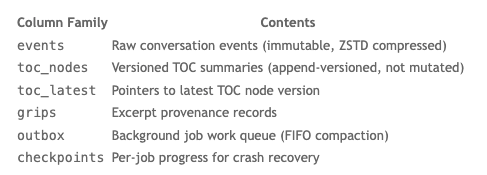
Six column families partition the data logically within one RocksDB instance:
events
Raw conversation events (immutable, ZSTD compressed)
toc_nodes
Versioned TOC summaries (append-versioned, not mutated)
toc_latest
Pointers to latest TOC node version
grips
Excerpt provenance records
outbox
Background job work queue (FIFO compaction)
checkpoints
Per-job progress for crash recovery
Tantivy handles full-text search. It is a Lucene-quality BM25 search engine written entirely in Rust. The BM25 index covers TOC node summaries and grip excerpts. When an agent asks “find sessions where we discussed the authentication flow”, Tantivy teleports directly to relevant TOC nodes without scanning every event. Critically, the Tantivy index is disposable: it can be fully rebuilt from RocksDB at any time. RocksDB is the source of truth.
usearch provides approximate nearest-neighbor search using the HNSW algorithm. This is the vector search layer for semantic queries. Like the BM25 index, it is derived from and rebuildable from RocksDB.
Candle is Hugging Face’s ML framework written in Rust. agent-memory uses it to run the all-MiniLM-L6-v2 model locally, producing 384-dimensional embeddings for every conversation event and TOC summary. No external API calls. No API keys. No network dependency for embedding generation. The system works fully offline; embeddings are deterministic, and there are no embedding costs.
💡 Note: All embedding inference runs locally via Candle. You do not need an OpenAI API key or any network connection to use semantic search. The all-MiniLM-L6-v2 model runs on CPU with acceptable performance for background indexing.
tonic provides the gRPC server and client. All communication between clients (plugins, adapters) and the daemon uses protobuf-defined RPCs. This gives strong typing, binary efficiency, streaming support, and generated client stubs for multiple languages.
tokio-cron-scheduler handles the background job pipeline: TOC summarization rollups, BM25 index sync, vector index sync, topic graph refresh, and retention cleanup. CancellationToken enables graceful shutdown without leaving indexes in inconsistent states.
Architecture: The 6-Layer Cognitive Stack
The central architectural principle of agent-memory is this:
💡 Key Design: “Indexes are accelerators, not dependencies.” The TOC hierarchy is always available. Every other layer is optional and degrades gracefully. The system never fails completely just because a secondary index is missing or being rebuilt.
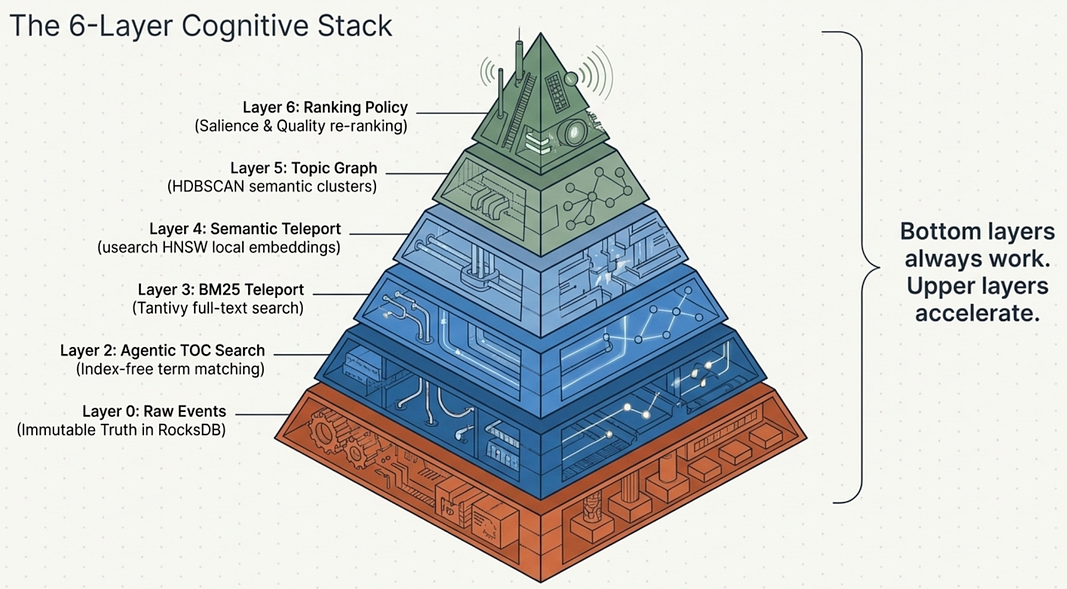
This principle shapes the entire retrieval stack. There are six layers, each adding capability while remaining optional beyond layer one.
Six-layer pyramid diagram of AI cognitive memory architecture: from raw events at the base to ranking policy at the apex.
Think of these layers as a pyramid of progressively smarter search. The bottom layers always work. The upper layers accelerate and refine.
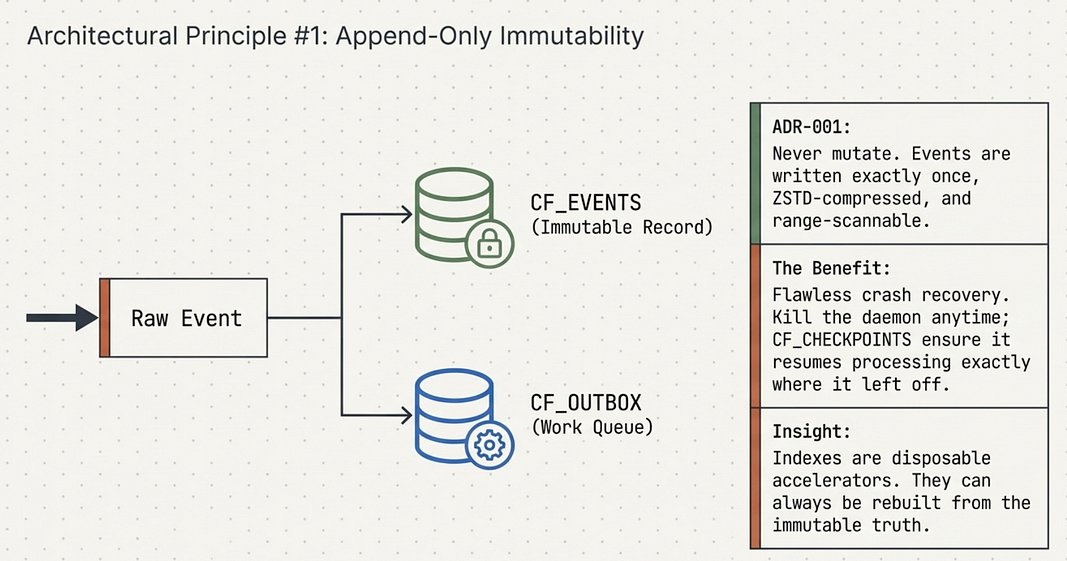
Layer 0: Raw Events is the immutable truth layer. Every conversation event is stored exactly once with a time-prefixed key: evt:{timestamp_ms}:{ulid}. These events are never modified, are ZSTD-compressed, and are range-scannable. Every other layer is built from this foundation.
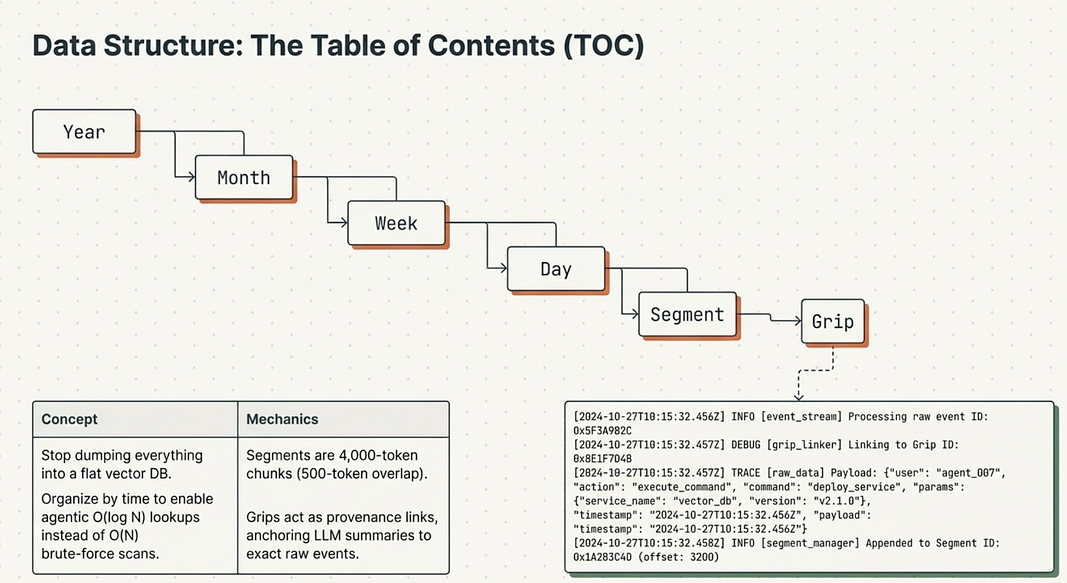
Layer 1: TOC Hierarchy converts raw events into navigable summaries. Background jobs periodically summarize conversations into a Year > Month > Week > Day > Segment tree. Each TOC node contains a title, bullet points summarizing key topics, keywords, and links to child nodes. An agent navigating this tree follows what the system calls Progressive Disclosure Architecture (PDA): start at Year, drill to Month, then Week, then Day, then Segment, reading summaries at each level and deciding whether to go deeper. This is O(log N) versus brute-force O(N) scanning.
Layer 2: Agentic TOC Search provides index-free search within the TOC structure. The SearchNode and SearchChildren RPCs traverse the TOC tree doing term matching against summaries. This is slower than indexed search, but it has zero external dependencies and always works, even if the BM25 and vector indexes are being rebuilt.
Layer 3: BM25 Teleport is where Tantivy comes in. Instead of navigating the TOC tree level by level, BM25 search teleports directly to the most relevant TOC nodes and grips based on keyword matching. A query like “authentication session timeout” goes directly to the relevant day or segment nodes.
Layer 4: Semantic Teleport adds embedding-based similarity. The usearch HNSW index finds TOC nodes and grips that are semantically related to the query, even when they use different keywords. The results of BM25 and semantic search are fused using reciprocal rank fusion (RRF) for hybrid retrieval.
Layer 5: Topic Graph operates above individual conversations. HDBSCAN clusters all conversation embeddings into named topics. LLM calls label each topic and assign importance scores. A time-decay function dims older topics. This layer answers questions like “what themes have I been working on this month?” by routing through topic clusters rather than time-based navigation.
Layer 6: Ranking Policy is the final quality layer. It applies the salience formula, usage-based decay, and novelty gating to re-rank results. High-salience memories (constraints, definitions, procedures) rank higher. Frequently-recalled items get slight deprioritization to surface less-seen but relevant content. Very similar results get filtered for novelty.
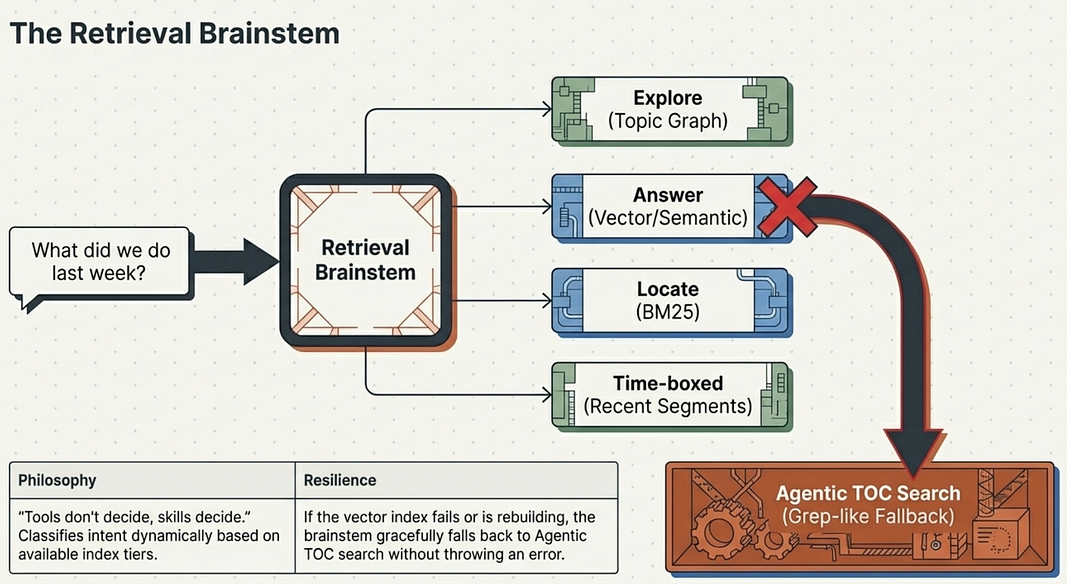
The Retrieval Brainstem sits alongside this stack as the decision router. It classifies query intent (Explore, Answer, Locate, Time-boxed), detects which capability tiers are available, builds a search plan, executes fallback chains if a tier fails, and applies stop conditions to prevent unnecessary work. The brainstem is what makes this AI agent memory system behave intelligently rather than executing every layer for every query.
Key Concepts: TOC, Grips, Segments, Outbox
Understanding four core concepts unlocks the rest of the system.
Table of Contents (TOC) is the primary navigational data structure. It is a time-indexed hierarchy: Year at the root, then Month, then Week, then Day, then Segment at the leaves. Each node contains an LLM-generated summary with a title, bullet points covering key topics, and keywords. Because it is time-based, navigating it is always predictable: you know where to look for “last Tuesday” without any index.
The Progressive Disclosure Architecture (PDA) built on top of the TOC lets an agent navigate like a human scanning a table of contents. Start at Year. “Is this the right year?” Yes. Drill to Month. March. Drill to Week. The week of March 10. Drill to Day. “March 15th summary looks relevant.” Drill to Segment. Read the actual conversation context. At each level, the agent reads a compact summary and decides whether to continue drilling or pivot laterally. This is the human reading pattern applied to machine memory.
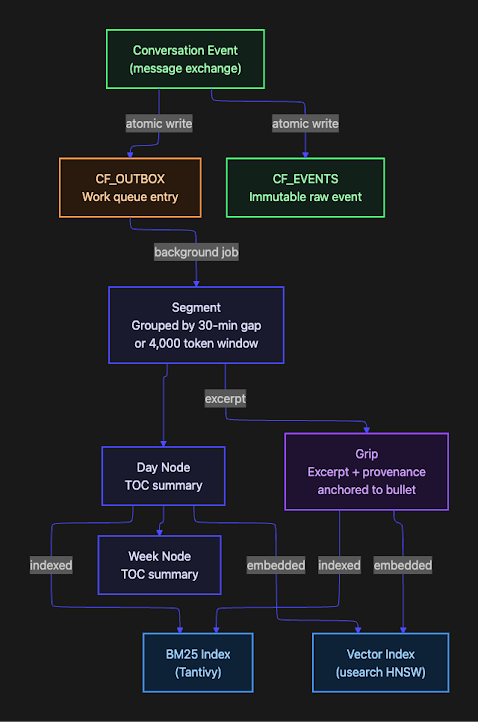
Grips are provenance records. A grip is an excerpt from raw events anchored to a specific bullet point in a TOC summary. When a Day node says “Discussed: using HNSW for approximate nearest-neighbor search”, the grip is the actual message exchange that produced that bullet. Grips link the compressed summary layer to the immutable truth layer.
This matters for reliability. Without grips, an agent citing a TOC summary has no way to verify the claim. With grips, it can expand any bullet point back to the original conversation. Salience fields were added to grips in Phase 16, so grips now carry their own importance scores.
Segments are the leaf level of the TOC hierarchy. A segment groups conversation events by time (default: 30-minute gap between events ends a segment) or by token count (default: 4,000 tokens, with 500-token overlap into the next segment for context continuity). The token-based splitting ensures no segment is too large for LLM summarization. The overlap prevents hard context cuts at segment boundaries.
The Outbox Pattern handles crash recovery. When a conversation event arrives, it is written atomically to two places simultaneously: CF_EVENTS (the immutable record) and CF_OUTBOX (a work queue entry). Background jobs drain the outbox, processing events into TOC nodes, BM25 index entries, and vector index entries. A CF_CHECKPOINTS column family tracks processing progress per job type. If the daemon crashes mid-processing, the checkpoint tells it exactly where to resume. No events are lost. No events are double-processed.
Agent AI: Agent Memory TOC, Year, Month, Week, Day, Segment, and Grip data structure
Agentic Based Temporal Search based on PDA
The search strategy built on the TOC hierarchy is fundamentally agentic, mirroring the Progressive Disclosure Architecture (PDA) that agent skills employ. The agent doesn’t blindly execute a fixed retrieval plan; it reads, decides, and adapts. Teleportation might take the agentic search to a point in time, but even if it does not the agentic search can always rely on the ability to do temporal based searches.
Agentic Navigation Pattern: The agent starts at a high-level TOC node (Year or Month). It reads the summary. Based on what it sees, it makes a decision: “Is this relevant? Should I drill down to the next level (Week, then Day, then Segment)? Or should I move laterally to the next Month or Year?” This is the same pattern a human uses when scanning a book’s table of contents.
The agent can also dynamically adjust its search scope. If a query is time-sensitive (“What did we discuss in the last 10 hours?”), the agent can skip high-level nodes entirely and go straight to the most recent Day or Segment nodes. If the query is exploratory (“What were the main themes last month?”), it might stay at the Week or Month level and read summaries without drilling to raw events.
Hybrid Agentic + Grep Strategy: The agentic TOC search can be combined with targeted grep-like queries. For example, the agent might decide: “I need to scan the last three weeks for mentions of ‘authentication timeout’.” It navigates to the Week nodes for the past three weeks, then uses SearchNode or SearchChildren RPCs to perform term matching across those specific nodes. This is more efficient than a brute-force scan of all events, because the agent narrows the search space first using the TOC structure.
The Retrieval Brainstem orchestrates these decisions. It classifies the query intent (Explore, Answer, Locate, Time-boxed), detects which search tiers are available (TOC-only, BM25, semantic, topic graph), and builds a search plan. If BM25 is unavailable, the brainstem falls back to agentic TOC search. If the query is time-boxed (“last 10 hours”), it routes directly to recent Day or Segment nodes and skips higher levels entirely.
Retrieval Brainstem, note even grep-like scan is not slow and does not happen inside of the agent. It is done inside of the Rust process scanning an in-memory mapped storage systems heavily utilizing OS page cache to give you the ultimate speed. This is not your coding agent grepping markdown. Even this is designed with absolute speed in mind.
This agentic approach is what makes the system feel intelligent. The agent isn’t just retrieving; it’s navigating, deciding, and adapting its strategy based on what it finds.
💡 Pro Tip: The outbox and checkpoint pattern means you can safely kill the daemon at any time. It will resume exactly where it left off when restarted. You do not need to worry about corrupting the memory system by shutting it down abruptly.
Salience Detection: Teaching Agents What Matters
Not all memories are equally important. The conversation where your team decided to never use global state is more important to recall than the conversation where you asked the agent to explain a function you already understood. An AI agent memory system that treats both equally will bury critical constraints under mundane observations.
AI Agent — Agent Memory — Salience Detection
Agent-memory solves this with salience detection: a scoring system that classifies importance at write time, stores it immutably on TOC nodes and grips, and incorporates it into retrieval-time ranking.
Why compute salience at write time rather than at query time? Because the system uses an append-only model. Immutable events produce immutable salience scores. There is no reindexing as the corpus grows and no per-query computational overhead.
length_density captures the intuition that denser, longer content tends to be more substantive. A single-line exchange (“yes, sounds good”) gets a low density score. A multi-paragraph technical discussion gets a high score. The value is capped at 1.0 and scaled by 0.45, so density alone contributes at most 0.45 to the final salience score.
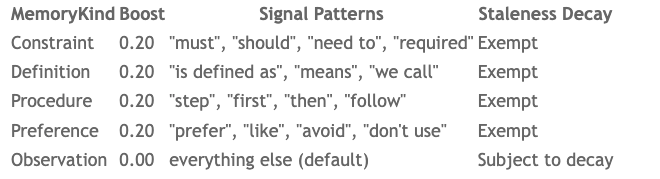
kind_boost adds 0.20 for high-signal memory kinds. The MemoryKind classifier inspects conversation content for signal patterns and assigns a category:
Constraint
Boost: 0.20
Signal Patterns: “must”, “should”, “need to”, “required”
Staleness Decay: Exempt
Definition
Boost: 0.20
Signal Patterns: “is defined as”, “means”, “we call”
Staleness Decay: Exempt
Procedure
Boost: 0.20
Signal Patterns: “step”, “first”, “then”, “follow”
Staleness Decay: Exempt
Preference
Boost: 0.20
Signal Patterns: “prefer”, “like”, “avoid”, “don’t use”
Staleness Decay: Exempt
Observation
Boost: 0.00
Signal Patterns: everything else (default)
Staleness Decay: Subject to decay
When the classifier sees “we must always validate input before calling the external API”, it recognizes “must” as a constraint signal and assigns Constraint kind. That memory gets a 0.20 boost and becomes exempt from staleness decay. Six months later, it still ranks at full strength.
pinned_boost adds another 0.20 when content has been explicitly pinned by the user. Pinning is a manual override for the classifier, useful when the content pattern is not obvious but the memory is clearly important.
A constraint that is long, dense, and pinned can reach a salience score of 0.45 + 0.20 + 0.20 = 0.85. A brief casual observation sits near zero.
At retrieval time, the ranking formula combines similarity with salience and a usage correction:
salience_factor scales from 0.55 (zero salience) to 1.00 (maximum salience). Even a zero-salience observation can still rank well if it is highly similar to the query. High-salience memories get a multiplicative boost on top of their similarity score.
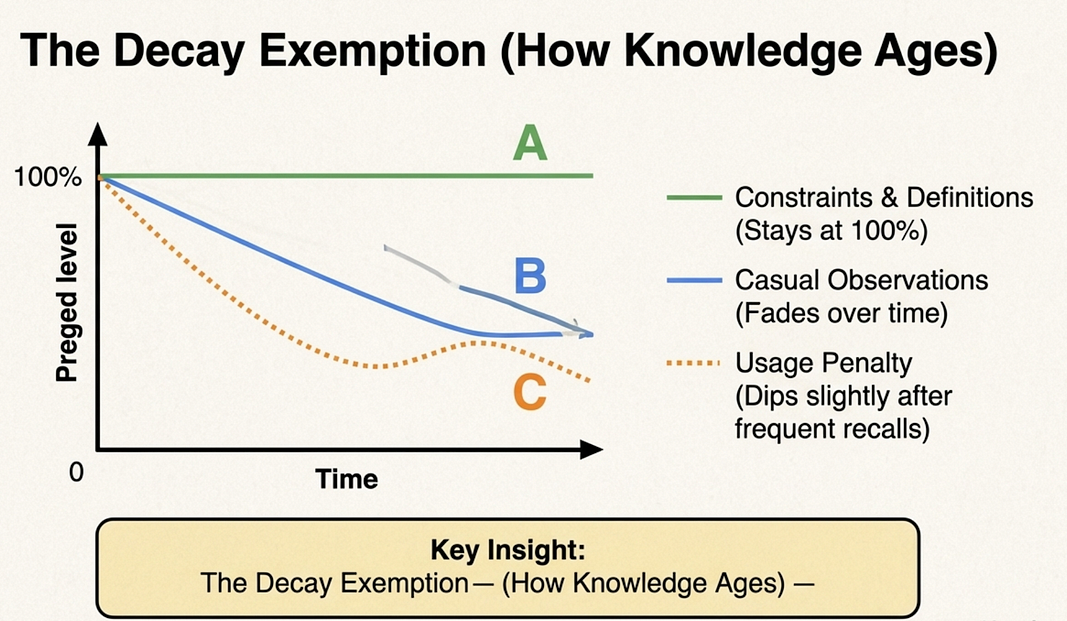
usage_penalty prevents high-value memories from dominating every query once they have been recalled many times. As access_count grows, the penalty increases, slightly deprioritizing frequently-recalled items. This surfaces less-recalled but relevant content the agent may not have seen recently.
Decay exemption
AI Agent: Agent Memory — Decay Exemption; How Knowledge Ages
The decay exemption for high-salience kinds is the most important rule in the system. Observations gradually dim as they age; staleness decay reduces their effective similarity weight over time. Constraints, definitions, procedures, and preferences are exempt. A constraint you set 18 months ago still ranks at full strength. An observation from 18 months ago is significantly dimmed.
💡 Key Design: The decay exemption encodes an important assumption: “your project’s constraints don’t expire; your casual observations do.” This is the memory system making an opinionated choice about what kind of knowledge ages well and what does not.
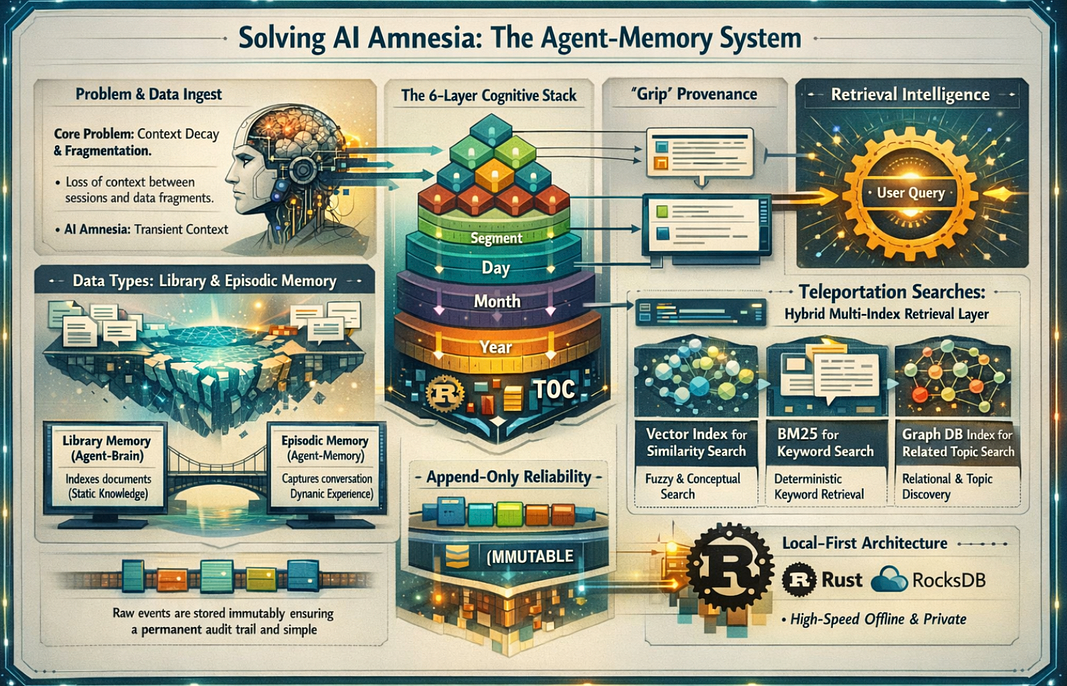
AI Agent: Agent Memory — 6 Layer Cognitive Stack taht includes salience detection and rerank, topic graph, semantic similarity search telportation, bm25 keyword search teleportation, and a PDA enabled Agentic layered temporal TOC search that can drill down from year, month, week, day to segment.
Memory Eviction: Retention Without Deletion
The append-only design means agent-memory never deletes raw events under normal operation. Events written to CF_EVENTS stay there. This simplifies crash recovery, provides an audit trail, and means you always have access to the original conversation transcript.
Append Only Architecture
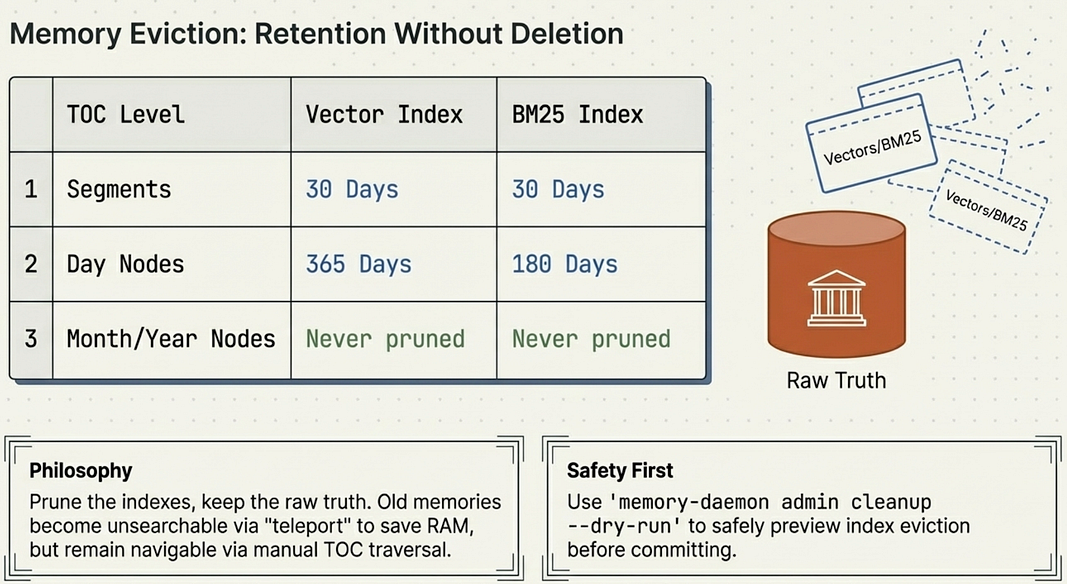
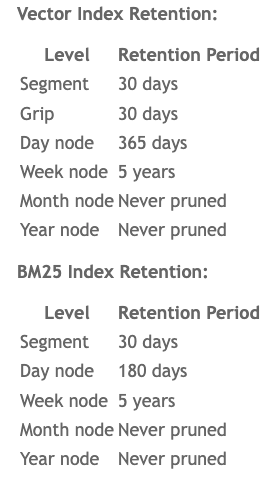
Retention policies operate on the derived indexes, not on raw data. When a retention policy runs, it prunes entries from the BM25 index and the vector index. The raw event survives. You lose searchability for old content, not the content itself. It can always be accessed via agentic search but loses the ability for teleportation.
💡 Note: Even after index pruning, raw events in CF_EVENTS remain intact. You can rebuild indexes from scratch at any time using memory-daemon admin rebuild-index. Old memories become unsearchable before they become unavailable.
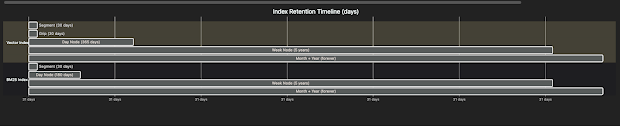
The retention matrix is tiered by TOC level. Granular data (segments, daily grips) ages out faster. High-level summaries (week, month, year nodes) are retained much longer or indefinitely. This mirrors how human memory works: you forget the exact words of a conversation from last year, but you remember the gist.
Automated cleanup runs via memory-daemon admin cleanup. The --dry-run flag shows what would be pruned without actually pruning it.
💡 Pro Tip: Always run memory-daemon admin cleanup --dry-run before your first live cleanup. The output shows exactly which index entries would be removed and at which TOC levels, so you can tune retention configuration before committing.
Retention is configurable per project: forever (default for most levels), 90 days, 30 days, or custom durations. Archive strategies include compress-in-place, export to file, or hard delete.
Topic graph pruning uses exponential time decay with a 30-day half-life. A topic that was active three months ago has decayed to 12.5% of its original importance. Topics that fall below the importance threshold during the weekly compaction job are pruned from the graph. This keeps the topic graph focused on current work rather than accumulating every topic forever.
Episodic memory pruning (Phase 44) applies a value-score threshold to Episode-kind memories. Episodes below the threshold are pruned from long-term storage during compaction. The value score combines the episode’s salience, outcome quality, and recency.
GDPR mode enables full data removal: no tombstones, complete deletion from all storage layers. Audit logging tracks every deletion event for compliance reporting.
Multi-Agent Memory Sharing
Most developers use more than one AI coding agent. Claude Code for complex architecture work, Cursor for quick edits, Copilot inline completions. Conversational AI context retention across multiple agents is a real challenge; agent-memory supports three strategies for handling memory across multiple agents, and you choose based on how much cross-agent sharing you want.
Strategy 1: Separate Stores (default)
Each agent gets its own physical RocksDB directory:
Physical isolation. One agent’s memory cannot affect another’s. Easy to delete: remove the directory to wipe one agent’s history cleanly. Project identification uses git repository root by default, falling back to a CWD hash if not in a git repo. Override with MEMORY_PROJECT_ID. We can store conversations by agent or project.
Strategy 2: Unified Store with Agent Namespacing
One shared RocksDB with an agent_id field on every event. Cross-agent queries become possible: you can ask "what did any agent discuss about the auth system this month?" This is useful when you want a single view of all agent activity on a project.
Strategy 3: Team Mode
Multiple users share a network-accessible daemon. Conversation memory from one developer’s Claude Code session can be recalled by another developer’s session. This enables cross-user knowledge discovery: “what has the team been working on this sprint?” without manually writing status updates.
Separate Stores
Isolation: Full physical
Cross-Agent Queries: No
Multi-User: No
Use When: Default; clean separation per agent
Unified + Namespacing
Isolation: Logical (agent_id)
Cross-Agent Queries: Yes
Multi-User: No
Use When: One developer, multiple agents
Team Mode
Isolation: None
Cross-Agent Queries: Yes
Multi-User: Yes
Use When: Shared project context across developers
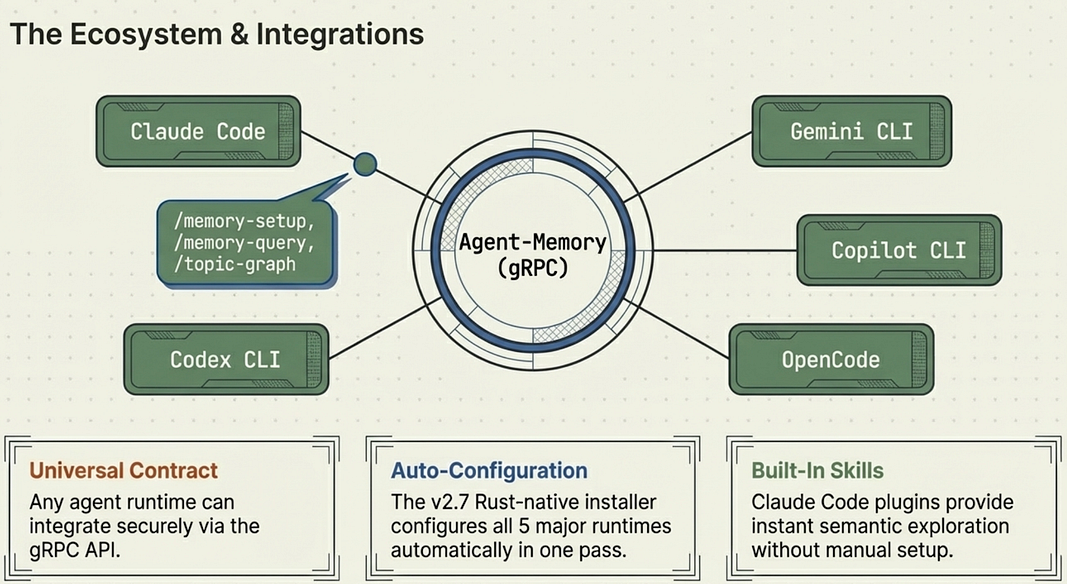
v2.7 shipped a Rust-native installer (the memory-installer crate) that generates correct configuration for five runtime targets in one pass: Claude Code, OpenCode, Gemini CLI, Copilot CLI, and Codex CLI. Previously, configuring each runtime required manual adapter setup. The installer handles all five automatically.
To support sharing from dev machine, we may end up using Kafka and/or NATS streaming. Then it is just a matter of subscribing and sharing streams. This is not in the current plans. But it is designed for this event stream architecture.
Integration: Claude Code Memory Plugin and Adapters
Agent-memory integrates with AI coding agents through a plugin and adapter layer. The daemon runs locally; plugins connect agents to it.
AI Agent: Agent Memory — Ecosystem and Integrations — Claude Code, Claude Agent SDK, Codex CLI, Gemini CLI, Copilot CLI, OpenCode CLI, OpenCode Agent SDK, and LangChain DeepAgents
memory-setup-plugin is the Claude Code memory plugin for installation and configuration. It provides three commands: /memory-setup (first-run wizard), /memory-status (health check), and /memory-config (configuration management). It includes a setup-troubleshooter agent for diagnosing common problems, and two wizard skills: memo-retention-wizard for configuring retention policies and memo-multi-agent-wizard for setting up multi-agent memory sharing.
memory-query-plugin is the Claude Code plugin for active memory queries. It provides four skills:
memory-query: Tier-aware retrieval with automatic fallback chains. Asks the Retrieval Brainstem to find relevant memories for the current session context.
memory-search: Explicit search with topic or keyword filtering and period-based filtering ("search last month").
memory-agents: Configuration wizard for multi-agent sharing scenarios.
topic-graph: Semantic topic exploration; shows what themes have been active recently and lets you browse by topic rather than by time.
These skills correspond to the /memory-query, /memory-search, and /topic-graph commands in Claude Code.
Adapters for other runtimes follow the same pattern: hooks capture events and forward them to the daemon as IngestEvent gRPC calls. The adapter intercepts conversation events from the host agent's hook system and translates them into the agent-memory protobuf format.
The gRPC API is the universal contract. Any agent runtime can integrate by implementing the hook-to-IngestEvent translation.
Claude Code is supported by default. Codex does not currently have a callback mechanism. It can read from agent-memory but currently there is no way for it to contribute conversational state. It should be easy to add support for Cursor in the future.
Also, we added LangChain DeepAgent to the roadmap.
Design Decisions: The ADRs as Design Stories
Agent-memory’s architecture is documented through Architectural Decision Records (ADRs). These are not dry technical documents. Each ADR captures a real problem, the options considered, and the reasoning that drove the choice. Reading them reveals the intellectual history of the system.
ADR-001: Append-Only Storage
The team faced a fundamental choice: allow event mutation (simpler for some operations) or commit to immutability (simpler for everything else). They chose immutability.
The payoff is substantial. Crash recovery becomes simple: replay the outbox from the last checkpoint and resume. There is a natural audit trail. Caching is safe because immutable data never invalidates. There are no tombstone records cluttering queries. The one difficult trade-off is privacy: GDPR requests require a full database wipe rather than targeted record deletion, unless GDPR mode is explicitly enabled. The team accepted that trade-off because the operational simplicity of immutability was worth it for the primary use case.
ADR-002: TOC-Based Navigation Over Pure Vector Search
This is the most architecturally distinctive decision in the system. Many teams building an AI agent memory system default to “put everything in a vector store and semantic-search it.” The agent-memory team rejected that as the foundation.
Their reasoning: vectors are “teleport accelerators” that skip levels in the TOC hierarchy, not the foundation itself. The TOC ensures the system always works, even when the vector index is being rebuilt or has never been built. Time is a universal organizing principle for conversations: “last Tuesday” always has a meaningful location in the TOC, regardless of what words were used in those conversations. A pure vector approach loses this navigational guarantee.
ADR-003: gRPC Only
No HTTP/REST API. The choice was deliberate: strong typing via protobuf definitions eliminates a class of serialization bugs. Binary efficiency over JSON matters for a high-throughput ingestion path. Built-in streaming handles large result sets without custom pagination logic. Generated client stubs in multiple languages keep the integration surface consistent. The trade-off is that gRPC clients are less ubiquitous than HTTP clients; you cannot use curl to query the daemon. The team decided that developer convenience with direct curl calls was less important than the long-term reliability benefits of typed interfaces.
ADR-004: RocksDB as the Single Storage Backend
An embedded key-value store eliminates the database server deployment problem. No PostgreSQL instance to manage, no connection pool to configure, no separate backup process. RocksDB runs inside the daemon process. The LSM tree structure is well-matched to the append-heavy workload. Six column families within one RocksDB instance provide logical separation between events, TOC nodes, grips, outbox, and checkpoints. The system deploys as a single binary with no external dependencies.
ADR-005: Grips for Provenance
Every TOC summary bullet is backed by a grip that links to source events. This decision addresses a trust problem: agents citing memory summaries should be able to verify those claims. Without grips, an agent might confidently state a constraint that was actually paraphrased incorrectly in the summary. With grips, it can expand any bullet back to the exact raw conversation. This matters most for Constraint and Definition memories: you want to know precisely when and why a constraint was established, not just that it exists.
ADR-007: Tantivy for BM25
Embedded, pure Rust, Lucene-quality BM25. The index is disposable and always rebuildable from RocksDB. No Elasticsearch or OpenSearch cluster to operate. Tantivy runs inside the daemon process. The choice reflects a consistent theme across all ADRs: prefer embedded, rebuildable components over external services.
ADR-008: Per-Project Stores
Default isolation prevents project cross-contamination. Each project directory gets its own RocksDB instance, typically keyed by git repository root. Deleting a project’s memory is a directory removal, not a database query.
The core philosophical principle binding all these decisions together:
💡 Key Design: “Tools don’t decide, skills decide.” The memory substrate (daemon, gRPC API, data plane) provides capabilities deterministically. Agentic skills (the query plugins, the wizard skills, the retrieval brainstem) encode the decision logic. The substrate stays reliable and stable; behavior evolves through skill updates without touching the core data layer.
This separation means you can improve how the system decides to search without risking the integrity of the stored events. The data plane and the control plane are kept distinct by design. That is not just an architectural preference; it is what allows the system to evolve without breaking production deployments.
Current Status: v2.7 and Beyond
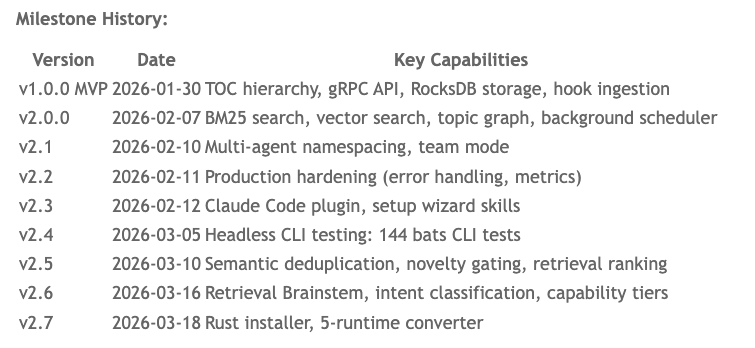
Agent-memory reached v2.7 on 2026–03–18. The project has moved well past MVP into trying to get to active production hardening.
Milestone History:
v1.0.0 (MVP) — 2026–01–30
TOC hierarchy
gRPC API
RocksDB storage
Hook ingestion
v2.0.0–2026–02–07
BM25 search
Vector search
Topic graph
Background scheduler
v2.1–2026–02–10
Multi-agent namespacing
Team mode
v2.2–2026–02–11
Production hardening (error handling, metrics)
v2.3–2026–02–12
Claude Code plugin
Setup wizard skills
v2.4–2026–03–05
Headless CLI testing (144 bats tests)
v2.5–2026–03–10
Semantic deduplication
Novelty gating
Retrieval ranking
v2.6–2026–03–16
Retrieval Brainstem
Intent classification
Capability tiers
v2.7–2026–03–18
Rust installer
5-runtime converter
Scale: The project spans approximately 50,000+ lines of Rust code across 14 crates, with 45+ end-to-end tests, 144 CLI tests (bats), 44 development phases, and 135 implementation plans.
The core data structures (append-only RocksDB, TOC hierarchy, gRPC API) are stable. The Ranking Policy (Phase 16), Cognitive Retrieval (Phase 17), Episodic Memory (Phase 44), and Multi-Runtime Installer (Phase 49) are all complete. The current focus is continued production hardening and expanding runtime support.
Conclusion
Agent-memory and agent-brain solve different problems, and you will likely want both.
Agent-brain gives your AI agents library memory: knowledge about your codebase, your documentation, your architecture decisions captured in documents. Use it when you need your agent to answer “what does our codebase say about X?”
agent-memory gives your AI coding assistants episodic memory: knowledge about the conversations themselves. Use it when you need your agent to answer “what did we decide about X last week?” or “what was the approach we settled on for Y in March?” This is what persistent AI agent context looks like in practice.
The amnesia problem is real and expensive. Every session that starts from scratch is a session where your agent is missing months of accumulated context: your team’s coding preferences, the constraints you established, the procedures you developed, the decisions you made and why. This episodic memory for AI agents captures all of that automatically, organizes it intelligently, and retrieves it without scanning everything.
The technical choices reflect a coherent philosophy. Rust for reliability. RocksDB for embedded persistence. Candle for offline embeddings. gRPC for typed interfaces. TOC for navigable hierarchy. Grips for provenance. Every choice points toward a system built for long-term operation with minimal operational overhead. No servers to manage beyond the local daemon. No API keys for embeddings. No data leaving your machine.
If you use an AI coding agent daily, your agent is accumulating a working history that is currently being discarded at the end of every session. agent-memory is the system that keeps that history and makes it retrievable.
Key Takeaways
agent-memory captures episodic memory for AI agents (conversation history); agent-brain captures library memory (documents and code). Both are necessary; neither replaces the other.
The six-layer cognitive stack gives the AI agent memory system graceful degradation: the TOC hierarchy always works, and faster layers accelerate it when available.
Salience detection classifies memory importance at write time, making high-signal content (constraints, definitions, procedures) decay-exempt and prioritized at retrieval.
The append-only design keeps raw events forever; retention policies only prune search indexes, so you can always rebuild.
Three multi-agent memory sharing strategies (separate stores, unified namespacing, team mode) cover the full range from strict isolation to cross-user knowledge sharing.
Next Steps
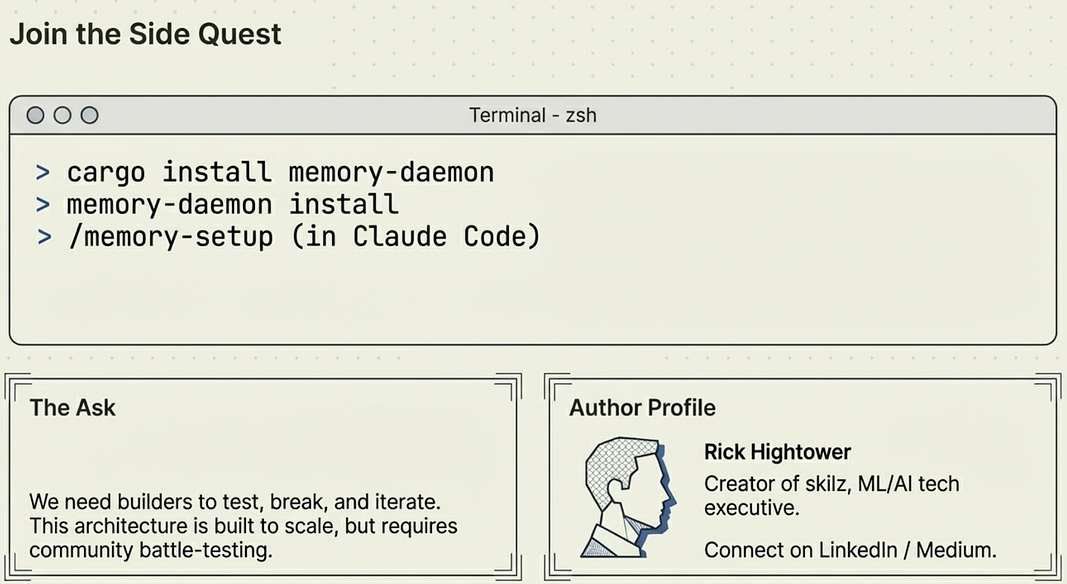
This is not ready for prime time. This is ready for people to test and help develop and provide feedback. It is a work in progress.
Install: cargo install memory-daemon and run memory-daemon install for your agent runtime.
Configure: use the Claude Code memory plugin /memory-setup for a guided first-run wizard.
Verify: run /memory-status to confirm the daemon is running and hooks are active.
Explore: after a week of sessions, use /topic-graph to browse what themes your sessions have covered.
Tune retention: run memory-daemon admin cleanup --dry-run to preview what would be pruned before committing to a retention policy.
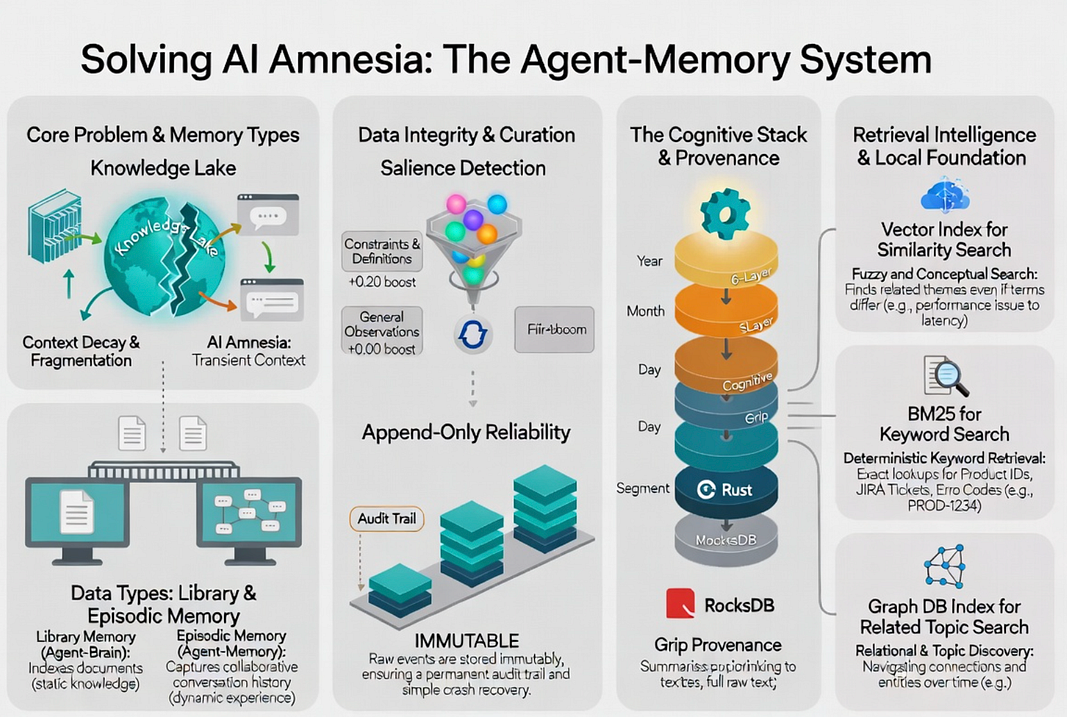
AI Agents — Agent Memory — Solving AI Amnesia at a glance
agent-memory is part of the broader ecosystem of tools giving AI coding agents persistent AI agent context. Combined with agent-brain for document retrieval and RuleZ for behavioral constraints, it forms a complete cognitive infrastructure for AI-powered development workflows.
About the Author
Rick Hightower is a technology executive and data engineer who led ML/AI development at a Fortune 100 financial services company. He created skilz, the universal agent skill installer, supporting 30+ coding agents including Claude Code, Gemini, Copilot, and Cursor, and co-founded the one of the world’s largest agentic skill marketplace (and one of the first). Connect with Rick Hightower on LinkedIn or Medium.
Rick has been actively developing generative AI systems, agents, and agentic workflows for years. He is the author of numerous agentic frameworks and developer tools and brings deep practical expertise to teams looking to adopt AI.
LangChain’s Harness Engineering: From Top 30 to Top 5 on Terminal Bench 2.0
Harness Engineering Techniques Propel LangChain’s AI Coding Agent from Mediocre to Exceptional Performance
🚀 Why did LangChain’s AI coding agent leap from #30 to #5 on Terminal Bench 2.0? The secret isn’t in the model; it’s all about the harness engineering! Discover how self-verification loops and clever middleware can supercharge your AI’s performance. Read the full story!
Summary: LangChain’s coding agent improved from 52.8% to 66.5% on Terminal Bench 2.0, moving from the Top 30 to the Top 5, through harness engineering techniques without changing the model. Key strategies included self-verification loops, loop detection middleware, and context engineering, which optimized agent performance by refining the surrounding infrastructure rather than the model itself. The article emphasizes the importance of verification, strategic reasoning allocation, and proactive context delivery for enhancing AI coding agents.
Part 6 of the LangChain Deep Agents Series
Your AI coding agent has the same model as the competition. Same weights, same training data, same capabilities. So why does it rank #30 while others sit comfortably in the Top 5?
LangChain asked that question and found an answer that surprised even them. Their coding agent, deepagents-cli, jumped from 52.8% to 66.5% on Terminal Bench 2.0, vaulting from outside the Top 30 into the Top 5. The model never changed. Not once. Every percentage point of that 13.7-point improvement came from what they call harness engineering: the systematic optimization of everything around the model.
TLDR: Our coding agent went from Top 30 to Top 5 on Terminal Bench 2.0. We only changed the harness. Here’s our approach to harness engineering (teaser: self-verification & tracing help a lot). — LangChain Blog
If you have been following this series, harness engineering is where all the concepts we have covered come together. The middleware patterns from Part 2, the context engineering from Part 5, the architectural principles from Part 1. This article is the proof point. Here is what happens when you apply them to a real benchmark competition.
This is the story of how LangChain did it. More importantly, it is a playbook of patterns you can apply to your own agents today.
What Terminal Bench 2.0 Actually Measures
Before we dig into the engineering, let’s understand the playing field.
Terminal Bench 2.0 is a benchmark developed by Stanford University and the Laude Institute. It evaluates AI coding agents on the kind of work that actually matters: long-horizon, complex terminal tasks in realistic environments. Unlike synthetic benchmarks that test isolated coding puzzles, Terminal Bench 2.0 presents agents with 89 Dockerized tasks across 10 technical domains, including software engineering, machine learning, security analysis, data science, and biology.
Each task runs in a containerized environment with pytest-based verification. There is no ambiguity about whether the agent succeeded or failed. And the tasks are genuinely hard. They require agents to maintain context across dozens of tool calls, navigate unfamiliar codebases, and solve problems that demand both technical knowledge and creative thinking. One task asks agents to reverse-engineer C programs from images. Another involves managing complex git merge conflicts across multiple branches. Some extended tasks, like COBOL modernization, require 100+ tool calls over roughly 10 minutes.
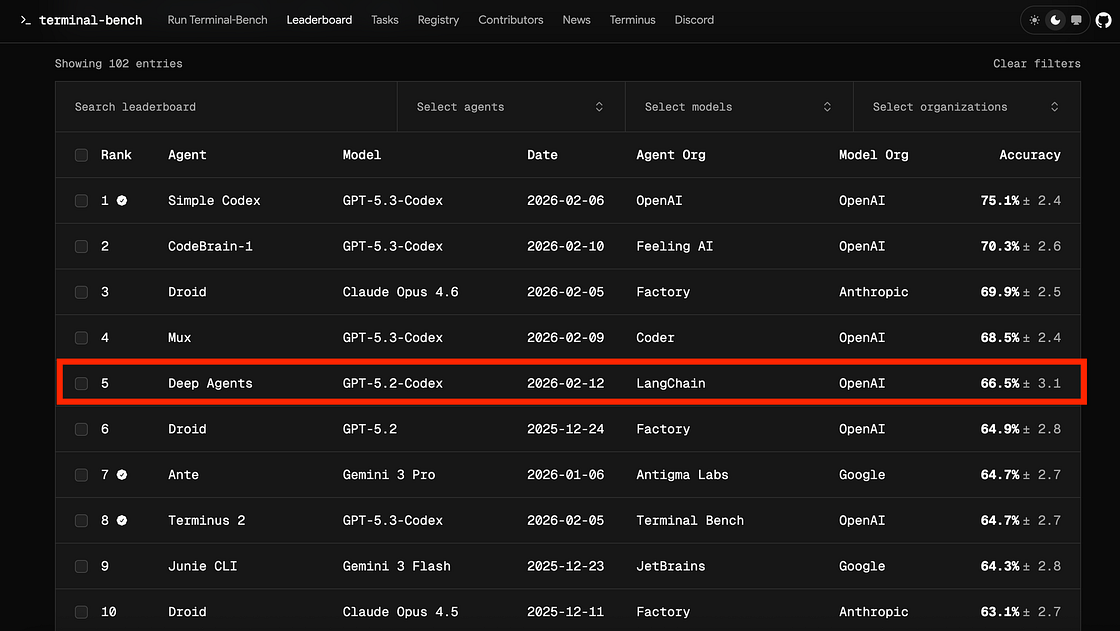
Here is what the current leaderboard looks like as of Febuary 2026:
Rank — Agent — Model — Accuracy
1 — Simple Codex — GPT‑5.3‑Codex — 75.1% ± 2.4
2 — CodeBrain‑1 — GPT‑5.3‑Codex — 70.3% ± 2.6
3 — Droid — Claude Opus 4.6–69.9% ± 2.5
4 — Mux — GPT‑5.3‑Codex — 68.5% ± 2.4
5 — Deep Agents — GPT‑5.2‑Codex — 66.5% ± 3.1
6 — Droid — GPT‑5.2–64.9% ± 2.8
7 — Ante — Gemini 3 Pro — 64.7% ± 2.7
8 — Terminus 2 — GPT‑5.3‑Codex — 64.7% ± 2.7
9 — Junie CLI — Gemini 3 Flash — 64.3% ± 2.8
10 — Droid — Claude Opus 4.5–63.1% ± 2.7
Notice something? Deep Agents appears in 5th place alongside several bespoke coding agents built around the same frontier models. At that time, GPT‑5.3‑Codex–based agents (Simple Codex, CodeBrain‑1, Mux, Terminus 2) and Claude‑ and Gemini‑based agents (Droid with Claude Opus 4.6/4.5, Ante with Gemini 3 Pro, Junie CLI with Gemini 3 Flash) all cluster in the mid‑60s to mid‑70s on Terminal‑Bench 2.0. Deep Agents, wrapping GPT‑5.2‑Codex, lands at 66.5% — within a few points of the best published GPT‑5.3‑Codex and Claude Opus 4.6 agents in that February 2026 snapshot, underscoring how much the harness can narrow the gap between underlying models. To highlight this further, Terminus 2 scored in 8th place and it is using a new and improved version of GPT Codex. The engineering harness can matter more than the model.
Terminal‑Bench 2.0: LangChain DeepAgent scored above Codex, Claude Code, OpenCode, and Gemini CLI. Copilot was not on the list. LangChain DeepAgent is pretty amazing.
Key point: This leaderboard tells a story that every AI engineer needs to hear: if you are spending all your time evaluating models and none building infrastructure, you are optimizing the wrong thing.
Agent = Model + Harness
This brings us to the core insight that drove LangChain DeepAgent’s improvement.
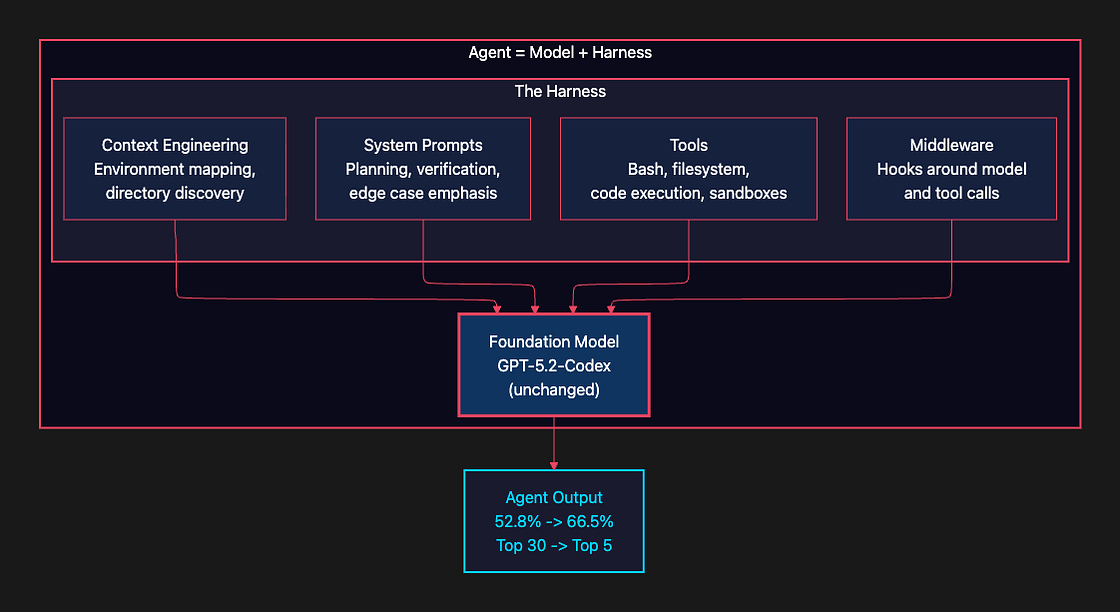
LangChain frames the relationship simply: an agent equals a model plus a harness. The harness is every piece of code, configuration, and execution logic that is not the model itself. System prompts, tools, middleware, execution flows, sandboxes, filesystems, and memory management all belong to the harness.
Agent = Model + Harness
The harness serves four distinct functions:
Constrain: Limit what the agent can do through sandboxes, hooks, command allow-lists, and network isolation. This prevents the agent from going off the rails in ways that waste time or cause harm.
Inform: Deliver the context the agent needs, including environment mapping, task specifications, and codebase structure. Anything the agent cannot access in-context does not exist to it.
Verify: Check the agent’s work through testing and validation. This is where most performance gains come from.
Correct: Fix failures through feedback mechanisms like loop detection and context reinjection. When the agent goes wrong, the harness nudges it back.
Models have what LangChain calls “spiky intelligence.” They are brilliant at some things and surprisingly bad at others. A model might write elegant code but forget to run it. It might solve a complex algorithm but skip reading the task requirements carefully. The harness smooths out those spikes.
As LangChain’s Vivek Trivedy puts it: “The purpose of the harness engineer is to prepare and deliver context so agents can autonomously complete work.”
For Terminal Bench 2.0, the team deliberately compressed their optimization space to just three knobs:
System prompts that guide how the agent plans, executes, and verifies
Tools that give the agent capabilities like bash execution and filesystem access
Middleware that hooks into model and tool calls to intercept and redirect behavior
Let’s examine each technique they applied, starting with the one that had the biggest impact.
Self-Verification Loops: Teaching Agents to Check Their Work
The single most impactful improvement came from self-verification. If you have built agents, you have probably seen this failure mode: the model writes a solution, glances at it, decides it looks reasonable, and moves on. It has a bias toward accepting its first plausible output. This is confirmation bias baked into the way these models work, and it kills benchmark scores.
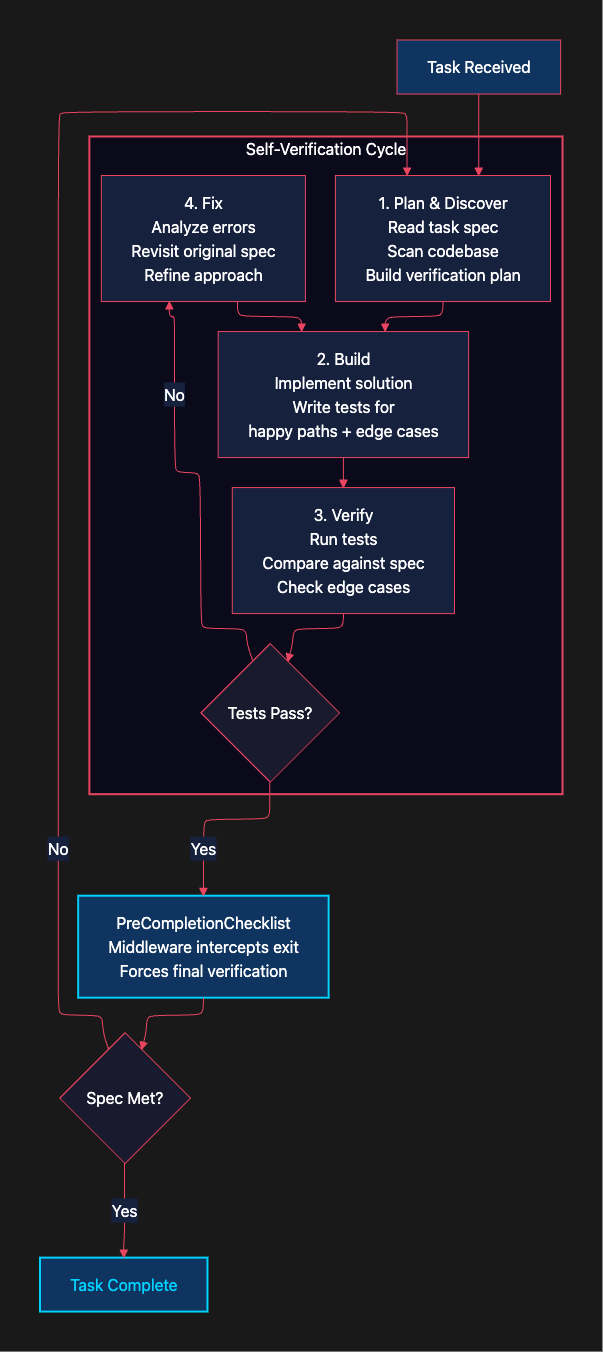
LangChain attacked this with a four-stage verification cycle embedded in the system prompt:
Self-Verification Loops
Stage 1: Plan and Discover. The agent reads the task specification, scans the codebase, and builds a verification plan before writing a single line of code. This alone eliminates a class of failures where agents dive straight into coding without understanding the problem. Think of it as the “measure twice, cut once” principle applied to AI coding.
Stage 2: Build. The agent implements the solution and writes tests covering both happy paths and edge cases. The emphasis on edge cases is deliberate. Without explicit instructions to test edge cases, agents tend to solve the obvious case and miss the tricky ones that Terminal Bench evaluates.
Stage 3: Verify. The agent runs those tests and compares results against the original task specification. This is where most improvements happen. Instead of relying on the model’s judgment about whether code “looks right,” the agent gets concrete pass/fail signals from actual test execution. Tests provide a feedback channel that is far more reliable than the model’s own assessment.
Stage 4: Fix. When tests fail, the agent analyzes the errors and revisits the original specification rather than just tweaking the failing code. This distinction matters. Tweaking code without revisiting the spec leads to patches that fix symptoms without addressing root causes.
The key enforcement mechanism is the PreCompletionChecklistMiddleware. This middleware intercepts the agent every time it tries to exit, forcing it through a final verification pass:
classPreCompletionChecklistMiddleware(Middleware): """Intercepts agent exit to force verification against task spec."""
def__init__(self, checklist_items: list[str] = None): self.checklist_items = checklist_items or [ "Have you read the complete task specification?", "Did you run all tests and verify they pass?", "Have you checked edge cases beyond the happy path?", "Does your solution match the exact file paths in the spec?", "Did you verify output format matches expected format?", ] async defon_model_call( self, state: AgentState, is_exit: bool ) -> MiddlewareResult: ifnotis_exit: return MiddlewareResult(continue_execution=True) # Agent is trying to exit -- inject verification prompt checklist = "\\n".join( f"- [ ] {item}"for item inself.checklist_items ) verification_prompt = ( "STOP. Before completing this task, verify each item:\\n" f"{checklist}\\n\\n" "Run any necessary tests to confirm. " "If any item fails, fix it before exiting." ) return MiddlewareResult( continue_execution=True, inject_message=verification_prompt, reset_exit=True, # Prevents exit, forces another loop )
The team calls this the “Ralph Loop” pattern, named after the Simpsons character who cheerfully announces “I’m in danger.” The agent thinks it is done, but the middleware sends it back. The name is whimsical, but the pattern is serious. It directly counters the model’s bias toward premature completion.
There are many frameworks that provide these sorts of checks for Claude Code, OpenCode, etc. For example, Superpowers is plan driven and TDD driven to the extreme that code can’t exist unless the plan and the test to test that code exists first. GSD also does a lot to enforce strict compliance and standards to the plan and GSD 2 goes even further. The whole spec driven movement is a nod in this direction but with varies degrees of looping and validation. When you enforce validation and feedback loops with specs and tests, you enforce this loop pattern.
Why this works: The verification loop transforms the agent’s interaction with its own output from a single pass (“write it and ship it”) into an iterative refinement process (“write it, test it, fix it, verify it again”). This mirrors how experienced developers actually work. Nobody ships code without running the tests.
Loop Detection: Breaking the Doom Loop
Self-verification pushes agents to keep iterating until they get it right. But that creates a new risk: what happens when the agent is stuck on a fundamentally wrong approach?
LangChain calls this the “doom loop.” The agent edits the same file ten or more times, making minor variations of the same broken strategy, never stepping back to reconsider. It is the coding equivalent of trying to force a puzzle piece into the wrong slot by rotating it slightly each time.
The LoopDetectionMiddleware addresses this by tracking per-file edit counts through tool call hooks:
classLoopDetectionMiddleware(Middleware): """Detects repetitive editing patterns and injects course corrections."""
def__init__(self, max_edits_per_file: int = 5): self.max_edits = max_edits_per_file self.edit_counts: dict[str, int] = defaultdict(int) async defon_tool_call( self, state: AgentState, tool_call: ToolCall ) -> MiddlewareResult: if tool_call.name in ("edit_file", "write_file"): file_path = tool_call.args.get("path", "") self.edit_counts[file_path] += 1 ifself.edit_counts[file_path] >= self.max_edits: return MiddlewareResult( continue_execution=True, inject_message=( f"You have edited {file_path} " f"{self.edit_counts[file_path]} times. " "Step back and reconsider your approach. " "Review the original task specification." ), ) return MiddlewareResult(continue_execution=True)
Notice what this middleware does not do: it does not force the agent to change course. It adds a nudge at exactly the moment when the agent is most likely to be stuck. This is an important design choice. Hard stops would break legitimate cases where a file genuinely needs many edits. A contextual nudge preserves the agent’s autonomy while providing the information it needs to make better decisions.
The productive tension: Self-verification and loop detection work in creative opposition. The verification loop pushes the agent to keep trying until tests pass. The loop detector prevents that persistence from becoming stubbornness. Together, they keep the agent in a zone where it iterates productively without spinning its wheels. Think of it as providing both accelerator and brake pedals. Neither alone is sufficient.
LangSmith Traces as a Feedback Signal
The techniques above improved the agent, but how did the team know which improvements to make? How do you systematically debug an autonomous agent that runs 89 different tasks in isolated containers?
This is where LangSmith traces became the backbone of the development process.
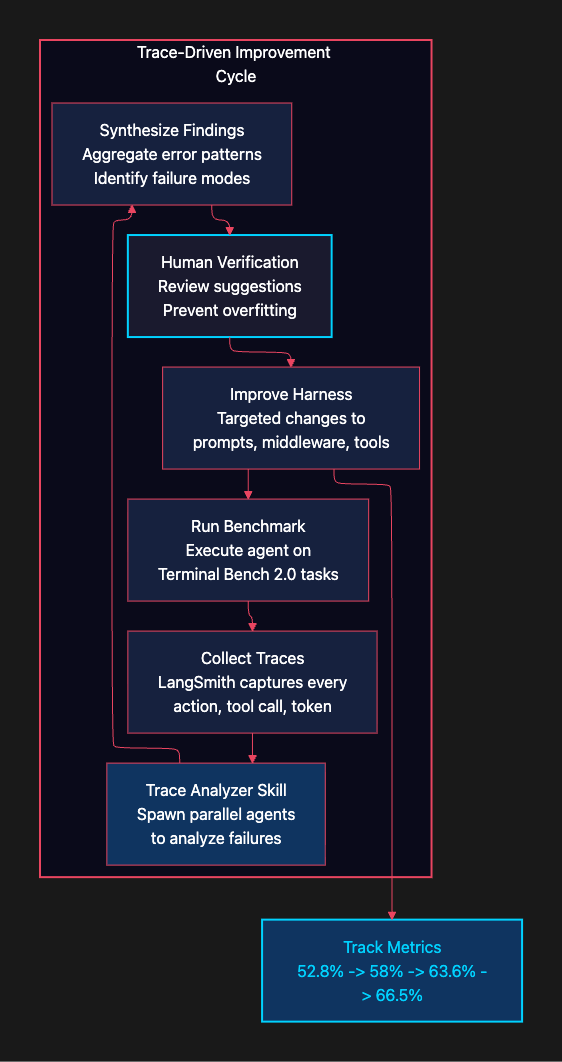
Trace Driven Improvement Cycle
Every agent run generates comprehensive traces in LangSmith: every tool call, every token generated, latency measurements, cost metrics. The team built what they call the “Trace Analyzer Skill,” an agentic workflow that turns those traces into actionable improvements.
Here is the key insight behind the Trace Analyzer: instead of manually reviewing dozens of failed runs, the team used agents to analyze agent failures. The workflow fetches failed traces from LangSmith, spawns parallel analysis agents to examine different failures simultaneously, and then synthesizes the findings into targeted harness changes:
asyncdefanalyze_failures(experiment_id: str): """Trace Analyzer Skill -- automated failure analysis.""" client = Client() # Step 1: Fetch traces from failed tasks failed_traces = [ t for t in client.list_runs( project_name="terminal-bench-eval", filter='eq(status, "error")', execution_order=1, ) ifnot t.outputs.get("success") ] # Step 2: Spawn parallel analysis agents analyses = await asyncio.gather(*[ create_agent( model="gpt-5.2-codex", system_prompt="Analyze this trace. Identify what went wrong, " "which middleware could prevent it, and suggest " "a specific harness modification.", ).run(format_trace(trace)) for trace in failed_traces ]) # Step 3: Synthesize into actionable improvements returnawait create_agent( model="gpt-5.2-codex", system_prompt="Synthesize failure analyses into prioritized " "harness improvements. Group by failure pattern.", ).run("\\n\\n".join(str(a) for a in analyses))
Think of this as gradient boosting for harness engineering. Just as gradient boosting focuses the next weak learner on the examples the ensemble gets wrong, the Trace Analyzer focuses the next harness iteration on the tasks the agent fails. Each cycle targets the remaining weaknesses, producing steady incremental improvement.
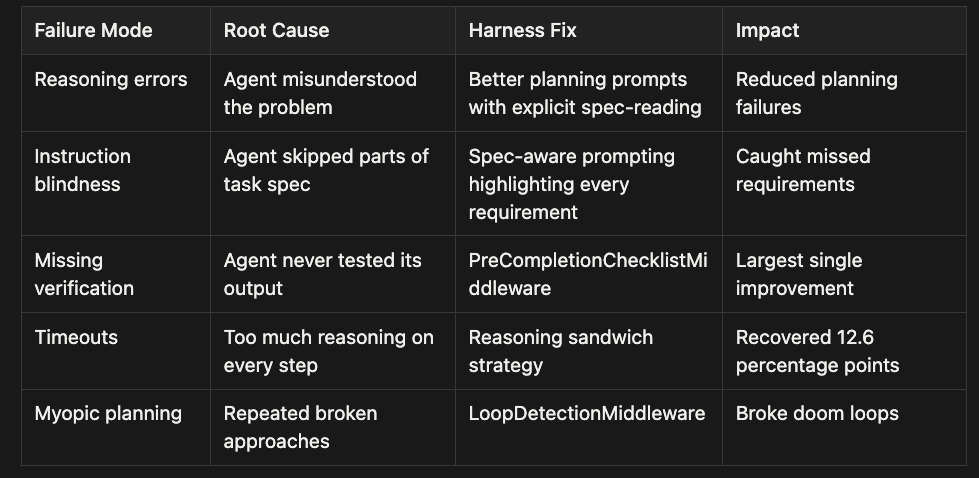
The failure modes they discovered and systematically addressed tell a story about what agents struggle with:
Reasoning errors: Agent misunderstood the problem → Fixed with better planning prompts with explicit spec-reading → Reduced planning failures
Instruction blindness: Agent skipped parts of task spec → Fixed with spec-aware prompting highlighting every requirement → Caught missed requirements
Missing verification: Agent never tested its output → Fixed with PreCompletionChecklistMiddleware → Largest single improvement
Timeouts: Too much reasoning on every step → Fixed with reasoning sandwich strategy → Recovered 12.6 percentage points
One critical detail: human verification sits between the analyzer’s suggestions and actual harness changes. Without this check, the team found they could overfit their harness to the specific failure modes of one benchmark run, making it worse on new tasks. The human reviewer ensures changes generalize across the full task distribution. This is a pattern worth remembering: even when you automate analysis, keep a human in the loop for decisions that affect the system’s general behavior.
The Reasoning Sandwich
Speaking of timeouts, let’s look at one of the more creative optimizations: the “reasoning sandwich.”
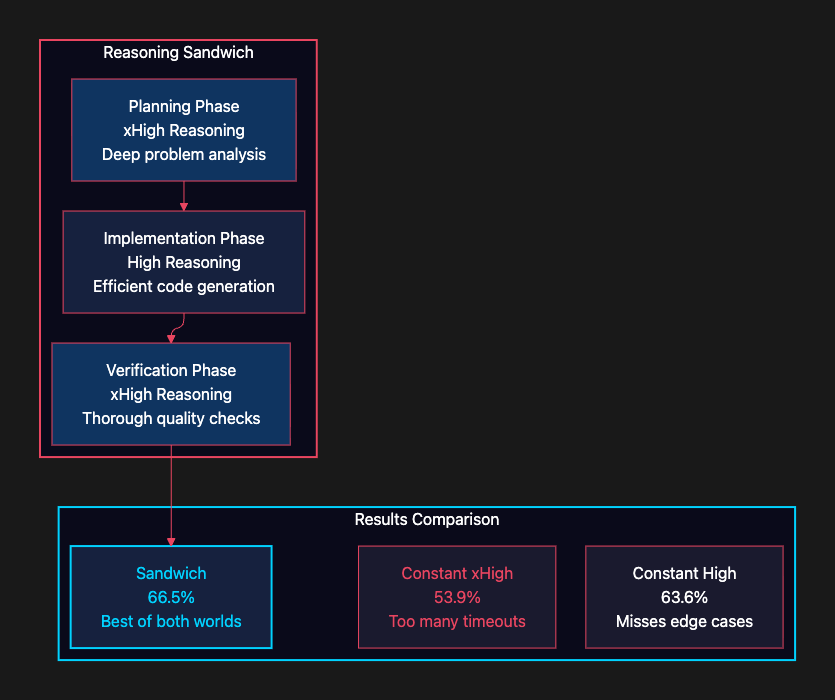
Reasoning Sandwich
Modern reasoning models let you control how deeply they think. The naive approach is to crank reasoning to maximum for everything. The LangChain team tried this, and it backfired:
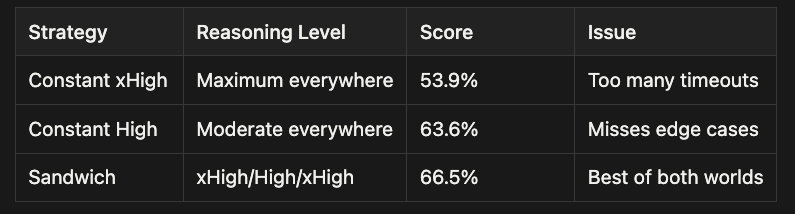
The team experimented with three different strategies for managing reasoning depth across agent execution. The first approach used constant xHigh reasoning: maximum cognitive effort at every step. This strategy achieved only 53.9% on the benchmark because the agent frequently ran into timeouts. While deep thinking is valuable, applying it uniformly consumed too much time budget, leaving tasks incomplete.
The second approach dialed back to constant High reasoning across all phases. This moderate level of cognitive effort improved performance significantly to 63.6% by avoiding timeouts. However, this strategy had its own weakness: it missed edge cases and subtle bugs that required deeper analysis to catch.
The winning strategy was the reasoning sandwich, which dynamically adjusts reasoning depth based on task phase. It uses xHigh reasoning during planning to deeply understand the problem, switches to High reasoning during implementation for efficient code generation, then returns to xHigh reasoning during verification to catch subtle issues. This adaptive approach achieved 66.5%: the best of both worlds. By allocating deep thinking strategically rather than uniformly, the sandwich strategy avoided timeouts while still catching the edge cases that moderate reasoning alone would miss.
The insight is elegant: not all phases of a coding task need the same depth of thought. Planning benefits from deep analysis because understanding the problem correctly is worth the time investment. Implementation can run at moderate reasoning because the plan already provides direction. Verification needs deep reasoning again because catching subtle bugs requires the same careful attention as understanding the problem initially.
The ReasoningSandwichMiddleware implements this by detecting the current task phase and adjusting the model's reasoning effort accordingly:
classReasoningSandwichMiddleware(Middleware): """Adjusts reasoning depth based on task phase."""
The 12.6-point gap between constant xHigh (53.9%) and the sandwich (66.5%) is remarkable. It means that thinking less during implementation actually improved results, because the agent had time budget left for the verification phase where deep thinking matters most. This is a lesson that applies beyond coding agents: strategic allocation of compute is more effective than brute-force maximum compute.
Context Engineering: Onboarding Your Agent
The final piece of the puzzle is environment onboarding. The LocalContextMiddleware runs when the agent starts up and does something deceptively simple: it maps the working environment before the agent sees its first task.
classLocalContextMiddleware(Middleware): """Onboards the agent by mapping its execution environment."""
async defon_agent_start(self, state: AgentState) -> MiddlewareResult: dir_structure = await self._map_directory(state.working_dir) tools_info = await self._discover_tools(state) context = ( f"## Working Environment\\n" f"**Current directory**: {state.working_dir}\\n\\n" f"### Directory Structure\\n{dir_structure}\\n\\n" f"### Available Tools\\n{tools_info}\\n\\n" f"Use this information to navigate efficiently. " f"Do not waste time discovering what is already mapped." ) return MiddlewareResult( continue_execution=True, inject_message=context, )
Think of this as onboarding a new developer. You would not throw a new hire at a codebase without telling them where things are, what tools are available, or how the project is structured. The middleware gives the agent the same orientation.
Without context engineering, agents waste tool calls on discovery. They run ls in every directory, try to locate Python by running which python and which python3 and checking PATH entries. Sometimes they get confused by unexpected directory structures and go down rabbit holes that consume their time budget. With proactive context delivery, they start productive work immediately.
This connects directly to the concept we explored in Part 5 of this series: context is not just about what information the agent has, but about when and how it receives that information. Front-loading environment context eliminates an entire category of early-task failures.
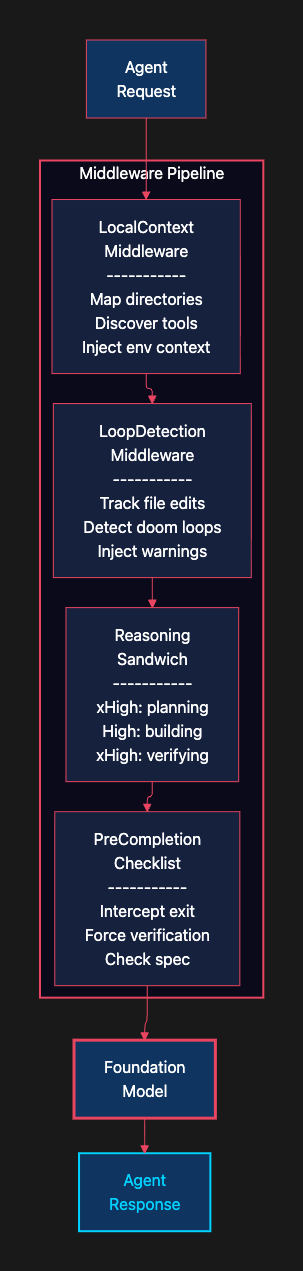
Putting It All Together: The Middleware Pipeline
All four middleware components compose into a single pipeline that processes every agent interaction:
LangChain DeepAgent: Middleware Pipeline
Here is how the full pipeline comes together in code:
from deepagents importcreate_cli_agent
agent= create_cli_agent( model="gpt-5.2-codex", middleware=[ LocalContextMiddleware(), LoopDetectionMiddleware(max_edits_per_file=5), ReasoningSandwichMiddleware(), PreCompletionChecklistMiddleware( checklist_items=[ "Read the complete task specification", "Run all tests and verify they pass", "Check edge cases beyond the happy path", "Verify output format matches expected format", "Confirm file paths match the spec exactly", ] ), ], tools=[bash_tool, edit_file, read_file, write_file, ls_tool], sandbox=HarborSandbox(provider="daytona"), )
Each middleware is independent and composable. You can add or remove layers without breaking the others. This modularity is what makes the approach practical for production use. You do not need to adopt the entire pipeline at once.
Lessons for Your Agents
The LangChain team distilled their experience into principles that apply far beyond Terminal Bench. Here are five you can act on today:
1. Verification beats generation. Investing in test execution and spec checking produces more improvement than better prompts or more powerful models. If your agent does not verify its work, that is your single highest-leverage improvement. Add a verification step before you try anything else.
2. Detect and break loops. Agents get stuck more often than you think. Simple heuristics like tracking edit counts per file can identify stuck agents before they waste your compute budget. Use a nudge, not a hard stop, to preserve the agent’s autonomy while redirecting its effort.
3. Trace everything, then use agents to analyze the traces. You cannot improve what you cannot see. Comprehensive tracing is not overhead. It is the feedback signal that makes systematic improvement possible. Using agents to analyze agent failures is a force multiplier that turns hours of manual review into minutes of automated analysis.
4. Allocate reasoning strategically. Not every step needs maximum compute. The reasoning sandwich (deep for planning and verification, efficient for execution) outperformed constant maximum reasoning by 12.6 percentage points. Think of reasoning compute as a budget to allocate, not a dial to crank.
5. Onboard your agent like a new hire. Proactive context delivery eliminates an entire class of discovery errors. Map the environment, locate tools, and inject structure before the agent starts working. Front-load the information your agent will need rather than making it discover everything on its own.
For teams ready to implement progressively:
Level 1 (1–2 hours): Add a verification step to your agent’s system prompt. Instruct it to run tests before completing any task. Track basic metrics with LangSmith or a similar observability tool.
Level 2 (1–2 days): Implement loop detection middleware. Set up comprehensive tracing for every agent run. Create an AGENTS.md file in your repositories to give agents project context from the start.
Level 3 (1–2 weeks): Build a trace analyzer workflow that automatically identifies failure patterns. Implement the reasoning sandwich for compute allocation. Add environment onboarding middleware. Version your harness alongside your code.
Conclusion
LangChain’s jump from Top 30 to Top 5 on Terminal Bench 2.0 is a proof point for a bigger idea: the infrastructure around a model matters as much as the model itself. In a world where everyone has access to the same foundation models, harness engineering is the differentiator.
The techniques in this article are not theoretical. They are battle-tested patterns extracted from a real benchmark competition, validated by a 13.7 percentage point improvement that came entirely from systems engineering. No model change. No fine-tuning. No magic. Just disciplined engineering of the systems that surround the model.
As models continue to improve, some of these guardrails will become unnecessary. Models will learn to verify their own work, manage their own context windows, and avoid doom loops on their own. LangChain themselves position these interventions as temporary measures that will become obsolete as models mature. But that day is not today. Today, the agent that wins is the one with the better harness.
Build yours.
This is Part 6 of the LangChain Deep Agents Series. Previous articles covered the Deep Agents architecture (Part 1), middleware patterns (Part 2), real-world use cases (Part 3), comparisons with Claude SDK (Part 4), and context engineering (Part 5).
LangChain DeepAgent Series: From Theory to Practice
This five-part series traced the full arc of the deep agent revolution, from identifying the problem to validating the solution in production.
Article 1: The Shift from Shallow to Deep established the problem. Shallow ReAct agents work brilliantly for simple, short-horizon tasks: look up a fact, run a query, return a result. But they break down on complex, multi-step problems. Context windows overflow. The agent loses sight of its original goal. There is no way to delegate specialized work. The shift from shallow to deep required four architectural pillars: extreme context engineering, planning tools, subagent spawning, and persistent file system access.
Article 2: Open-Source vs. Proprietaryexamined the tension between approaches. Claude Code proved that deep agent architecture works at scale. But its proprietary nature limited who could benefit. Deep Agents brought those same patterns to the open-source ecosystem, with trade-offs: more flexibility and transparency, but requiring more assembly and tuning. The convergence of these approaches created a healthier ecosystem where proprietary tools push innovation and open-source implementations make that innovation accessible.
Article 3: The Middleware Engine went under the hood. LangGraph provides the durable runtime that makes deep agents possible: state management, checkpointing, error recovery, and middleware hooks. The middleware system enables dynamic prompt injection, human-in-the-loop approval workflows, and model routing. Without this engine, deep agents would be fragile prototypes. With it, they are production infrastructure.
Article 4: Context Management and Security tackled the hardest operational challenges. As agents handle longer tasks, their context windows fill up. Deep Agents solve this with conversation history summarization, large tool result eviction, and filesystem-based context offloading. On the security front, runtime context injection prevents unauthorized data access, and the middleware layer enables PII masking, output filtering, and approval gates for sensitive operations.
Article 5: Real-World Use Cases (this article) brought it all together with evidence. The CLI puts the complete architecture in a developer’s hands with a single install command. Deep research, software engineering, and incident analysis demonstrate that the theory works in practice. And the market adoption confirms that the developer community agrees: over 10,500 stars, 62 contributors, and integration into LangChain’s three-library stack.
Article 6: The power of harness engineering. LangChain’s DeepAgent coding agent improved its performance from 52.8% to 66.5% on Terminal Bench 2.0 through harness engineering techniques, including self-verification loops, loop detection middleware, and LangSmith traces. The focus was on optimizing the infrastructure around the model rather than changing the model itself. Key strategies included a structured verification process, context onboarding, and strategic reasoning depth allocation, which collectively enhanced the agent’s ability to handle complex tasks effectively.
About the Author
Rick Hightower is a technology executive and data engineer who led ML/AI development at a Fortune 100 financial services company. He created skilz, the universal agent skill installer, supporting 30+ coding agents including Claude Code, Gemini, Copilot, and Cursor, and co-founded the world’s largest agentic skill marketplace. Connect with Rick Hightower on LinkedIn or Medium.
Rick has been actively developing generative AI systems, agents, and agentic workflows for years. He is the author of numerous agentic frameworks and developer tools and brings deep practical expertise to teams looking to adopt AI.
Related Articles
If you found this exploration of LangChain Deep Agents valuable, you might also enjoy these related articles that dive deeper into the topics of agent architecture, context engineering, and harness engineering:

 Posts
Posts